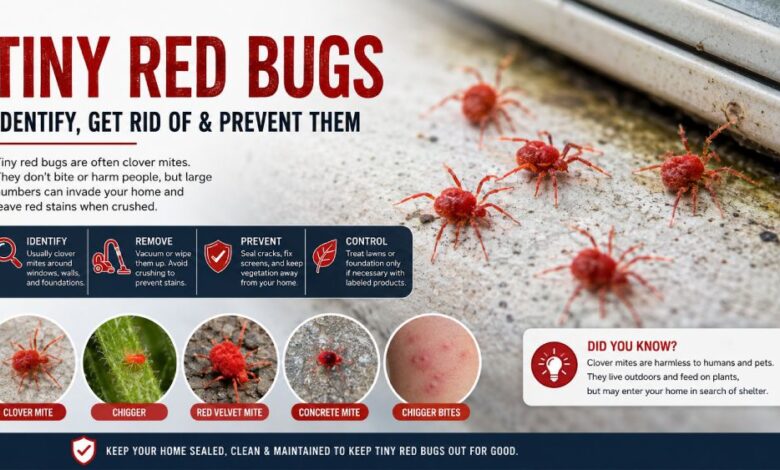
Tiny Red Bugs found around windows, walls, patios, lawns, or plants are often mites rather than true insects, and the most common household culprit is the clover mite (Bryobia praetiosa). Clover mites are extremely small, reddish-brown, oval-shaped arachnids with eight legs, including a noticeably long front pair that can look like antennae. They commonly live outdoors in lawns and vegetation and may move toward buildings, particularly around sunny walls, windows, doors, and foundation areas. They do not bite people or pets, do not transmit disease, and do not reproduce inside homes, although crushing them can leave conspicuous reddish stains. Other red mites can look similar, however, so location and behavior matter when identifying them.
How to Identify Tiny Red Bugs Around Your Home
The quickest way to narrow down the identification is to look at where the mites are found and how they behave rather than relying on color alone. Clover mites are usually seen crawling slowly across windowsills, exterior walls, patios, concrete, or around the foundation, especially where grass or other vegetation reaches the structure. They are approximately the size of a punctuation mark, and their long front legs are a useful identifying feature. If you crush one, it can leave a rusty-red streak. Chiggers are different: their larvae are only about 0.15–0.3 mm wide, are associated with grassy or vegetated outdoor areas, and are primarily a skin-biting nuisance rather than a household-invasion pest. Completely red mites seen on pavement, soil, or mulch may instead be velvet or “concrete” mites, which can have different habits and may prey on other small organisms.
Are Clover Mites Dangerous to People or Pets?
For most homeowners, the reassuring answer is no: clover mites are nuisance pests rather than a health threat. University extension sources report that they do not bite people or pets, do not carry diseases, do not infest stored food, and do not damage household structures or furnishings. Their main indoor problem is their sheer visibility when large numbers enter through cracks, window gaps, screens, and other openings. They can also create red marks when accidentally crushed against curtains, carpets, walls, upholstery, or windowsills. Chiggers are a separate concern because their larvae can cause intensely itchy reddish welts after outdoor exposure, particularly around tight clothing areas such as ankles and waistbands; they should not be confused with clover mites simply because both may appear reddish.
Why Are Tiny Red Bugs Coming Inside?
When Tiny Red Bugs suddenly appear around windows or walls, the source is usually outside rather than an indoor breeding population. Clover mites spend their active life outdoors feeding on plant material, especially grasses and clover, and populations can become particularly noticeable around lush, heavily fertilized lawns or vegetation growing close to a building. They can enter through small cracks around window frames, doors, foundations, screens, and other exterior openings, with sunny sides of buildings often attracting larger numbers. Spring is a particularly common period for activity, although fall invasions also occur and local weather can change the timing. Because clover mites do not establish a normal indoor infestation, finding hundreds indoors does not necessarily mean they are breeding throughout the house.
How to Get Rid of Tiny Red Bugs Indoors
For a small indoor infestation, physical removal is usually the most sensible first step because clover mites do not need to be poisoned inside the house. Use a vacuum cleaner with a hose attachment to gently collect them, then empty the vacuum appropriately so the mites do not remain inside it; a damp cloth can also remove small numbers from smooth surfaces. Avoid crushing them because their bodies can produce red stains that are especially noticeable on light-colored materials. Sticky traps placed near likely entry points can provide additional monitoring and removal. After cleaning, inspect window frames, door thresholds, screens, and foundation penetrations for gaps that could allow more mites inside. Extension specialists generally do not recommend indoor insecticide applications for clover mites because they are temporary outdoor invaders rather than insects establishing an indoor colony.
How to Stop Them From Coming Back
Long-term control works best when you reduce the route between the outdoor population and the house rather than repeatedly spraying indoors. Seal cracks around windows and doors with appropriate caulk, repair damaged weather stripping and screens, and keep vegetation from creating a continuous pathway to the foundation. Extension guidance commonly recommends maintaining an approximately 18–24-inch vegetation-free zone around the building; some extension programs recommend an even wider 3-foot or larger boundary depending on local conditions. Grass, weeds, leaf litter, and dense vegetation immediately against the foundation can provide favorable habitat or a bridge toward the structure. If the problem repeatedly occurs on one sunny side of the building, concentrate exclusion and landscape-management efforts there first.
Should You Spray the Lawn or Foundation?
Chemical treatment is not automatically necessary, and indiscriminate spraying can affect beneficial insects as well as nuisance mites. Extension recommendations vary according to local conditions, but exterior products labeled for clover mites may include active ingredients such as bifenthrin, permethrin, or cyfluthrin, while some guidance discusses insecticidal soaps or other labeled miticides for specific situations. Because mites are arachnids rather than insects, an ordinary insecticide is not automatically effective against every mite species. If a pesticide is used, choose a product whose current label specifically permits the intended site and pest, and follow its directions exactly; the EPA states that pesticide labels contain legally enforceable directions for safe use. Avoid spraying flowering plants, pollinator habitat, waterways, or areas where the product is not labeled for application.
DIY vs. Professional Mite Control
DIY control is usually appropriate when the problem consists of occasional mites on windows, walls, patios, or a small number entering indoors because exclusion and physical removal can address the immediate issue. A professional becomes more useful when large numbers repeatedly appear despite sealing and landscape changes, when the exact mite species is uncertain, or when the affected area is large enough that exterior treatment would be difficult or unsafe to perform yourself. A professional should inspect the foundation, vegetation, entry points, and surrounding landscape rather than simply applying a blanket spray. For general U.S. residential pest-control work, Angi’s August 2026 data places one-time pest-control visits around $108–$261 for a 1,500-square-foot home, although actual pricing depends heavily on pest type, location, property size, inspection requirements, and treatment scope; a clover-mite job may cost less or more than a general visit.
Common Mistakes When Dealing With Red Mites
The most common mistake is treating every red speck as the same pest and immediately reaching for an insecticide. Clover mites, chiggers, spider mites, and other red-colored mites have different habitats and behaviors, so identification should come before treatment. Another frequent mistake is crushing mites against walls or windows, which creates the red staining homeowners are often trying to avoid. Repeated indoor spraying also misses the underlying entry route when the population is actually outdoors. Finally, homeowners sometimes remove every plant around the house or apply broad-spectrum chemicals unnecessarily; a more targeted approach is to inspect the affected side of the building, correct gaps and screens, reduce vegetation directly against the foundation, and use pesticides only when a properly labeled treatment is genuinely needed.
When to Call a Pest Control Professional
Call a pest professional when you cannot confidently identify the organism, the population is persistent or unusually large, mites are entering through multiple inaccessible areas, or previous exclusion measures have failed. This is particularly worthwhile when the red organisms are associated with unexplained skin reactions, because chiggers and other biting arthropods require a different approach from harmless clover mites. A professional can collect or examine specimens, inspect exterior harborage areas, identify likely entry points, and determine whether treatment is actually justified. Before authorizing chemical treatment, ask what species was identified, where the treatment will be applied, which product will be used, whether it is labeled for that pest and location, and what precautions residents and pets need to follow.
Conclusion
Tiny Red Bugs around a home are often clover mites, and in that situation the problem looks much worse than it actually is because these harmless outdoor mites can appear in surprisingly large numbers. The practical solution is identification first, followed by vacuuming or wiping indoor mites without crushing them, sealing cracks and window gaps, maintaining a vegetation-free strip around the foundation, and correcting outdoor conditions that allow mites to reach the building. Chemical treatment should be considered only when necessary and should always match the pest, location, and current product label. If the bugs are biting, appearing on people after time in grass, damaging plants, or behaving differently from typical clover mites, do not assume they are the same pest; accurate identification is the safest route to effective control.
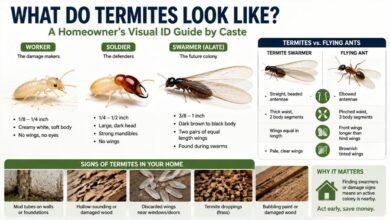
Also read: What Do Termites Look Like? A Homeowner’s Visual ID Guide by Caste
FAQs
Are tiny red bugs in my house clover mites?
They often are, especially when found around sunny windows, walls, and foundations, but a close inspection is needed because several mite species look similar.
Do clover mites bite humans?
No. Clover mites do not bite people or pets, although other red mites, including chiggers, can cause itchy skin reactions after outdoor exposure.
Why do clover mites leave red stains?
Their bodies contain reddish pigments, so crushing them against walls, carpets, curtains, or windowsills can leave noticeable rusty-red marks.
How do I get rid of clover mites naturally?
Vacuum indoor mites, seal cracks, repair screens, remove vegetation touching foundations, and maintain an 18–24-inch vegetation-free perimeter around the home.
Can clover mites infest my house?
Clover mites can enter homes in large numbers but generally cannot establish an indoor infestation because their normal food source and life cycle are outdoors.
What is the best way to prevent clover mites?
The most reliable prevention combines sealing exterior entry points with reducing vegetation immediately against the foundation and maintaining a clean barrier around the building.