
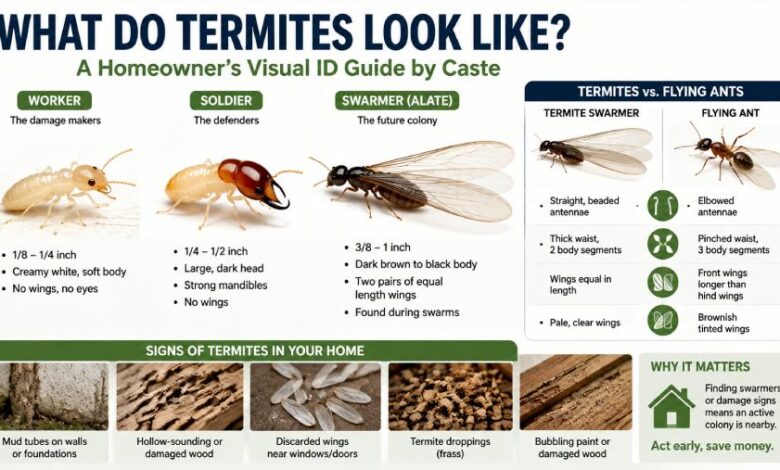
What do termites look like? Most are small, soft-bodied insects roughly 1/4 to 1/2 inch long, with straight bead-like antennae, a thick waist that runs in an unbroken line from head to abdomen, and — on the winged ones — two pairs of wings of identical length. That description covers the basics, but it hides the detail that actually matters in the field: a termite colony contains three castes that look almost nothing alike, and the one you find in your crawl space tells you something different from the one you find dead on your windowsill. This guide walks through each caste, the species differences that change how a home gets treated, the flying ant lookalike that fools most homeowners, the evidence termites leave behind when you never see the insects at all, and what identification and treatment realistically cost.
What Do Termites Look Like? The Short Answer
Across species, termites share a consistent build: a segmented body of head, thorax, and abdomen, six legs, straight antennae, and soft, pale-to-dark coloring depending on caste and species. Most references put the working size range at a quarter to half an inch, though the figure is not fully settled — Terminix stretches the range from one-eighth of an inch up to a full inch across all species and castes, so treat any single number as a rough guide rather than a diagnostic. The three features that separate a termite from nearly every insect it gets confused with are the antennae, the waist, and the wings. Termite antennae are made of many tiny bead-like segments and run more or less straight; they can curve and twist, but they never bend at a sharp elbow. The waist is broad, so the body reads as two visible segments rather than three. And on winged termites, all four wings are the same length. Get those three right and you have identified a termite without a microscope.
Worker Termites: Pale, Soft-Bodied, and Responsible for the Damage
Worker termites are the caste actually eating your house, and they are the ones you will find if you break open a mud tube or pull back a piece of damaged trim. They are the most numerous members of a colony, responsible for foraging, feeding the rest of the colony, caring for the queen and eggs, and maintaining the nest. Visually they are pale — creamy white, off-white, or translucent enough that they look almost see-through against dark wood — with soft bodies, no wings, and no functional eyes, typically measuring around a quarter inch or less. People frequently mistake them for maggots or small grubs, but workers have six clearly visible legs and a distinct rounded head, which fly larvae do not. Because workers never leave the protected environment of soil, wood galleries, or mud tubes, finding one out in the open is unusual and almost always means you have opened up an active infestation rather than stumbled across a stray insect.
Soldier Termites: Oversized Heads and Dark Mandibles
Soldiers are the easiest caste to identify with the naked eye because their heads look wrong for their bodies. They have soft, pale bodies similar to workers, but their heads are noticeably larger, harder, and darker — typically orange-brown to reddish-brown — and armed with strong pincer-like mandibles used to fight off ants and other predators. Some species carry a snout-like projection instead of large jaws, which they use to spray a defensive fluid. There is a detail here that surprises most homeowners and that says a lot about how a colony works: a soldier’s mandibles are too large for it to feed itself, so it depends entirely on workers for food. Soldiers are wingless and generally make up a small fraction of the colony, so if you find several of them in one spot, you have found the colony itself or a major feeding gallery, not the outer edge of one.
Termite Swarmers: The Winged Stage You’re Most Likely to See
Swarmers, also called alates or reproductives, are the only termites that fly and by far the most common ones homeowners actually encounter. They are darker and harder-bodied than workers, usually deep brown to black, and reported sizes cluster around 3/8 to 1 inch depending on species. Each swarmer carries two pairs of long, pale, translucent wings that extend well past the abdomen and are equal in size and shape. A useful magnifying-glass check that most identification guides skip: termite swarmer wings carry only two distinct veins and a few hairs, a far simpler pattern than the veined, tinted wings of a flying ant. After a swarm, mated pairs shed their wings and go looking for a nest site, which is why discarded wings pile up on windowsills, in spider webs, and near door thresholds. Seeing swarmers indoors is the single most urgent sign on this list, because colonies only produce them once they are mature — a swarm means an established colony is in or immediately against your structure.
Termites vs. Flying Ants: Three Details That Settle It
The flying ant is the lookalike responsible for most misidentification, and the University of Maryland Extension reduces the difference to three checks. Ants have elbowed antennae with a sharp bend; termites have straight, beaded ones. Ants have a pinched wasp waist that divides the body into three obvious segments; termites have a broad waist and read as two. Ants have front wings noticeably longer than the hind pair and usually brown-tinted; termite wings are all the same length, pale, and translucent. If the specimen is already dead and crushed, the wings alone often settle it — four matching wings means termite. Behavior helps too. Flying ants forage in the open and turn up around food and trash, while termites stay hidden inside wood or soil and become visible only during a swarm. Carpenter ants add a further wrinkle: they excavate wood without eating it and push out fine, fibrous sawdust, so sawdust-like debris is not automatic evidence of termites and can point you toward an entirely different treatment.
What Different Termite Species Look Like
Species matters more than most homeowners expect, because treatment method and cost hinge on where the colony actually lives. Subterranean termites — the most common type in the United States, present in nearly every state — nest in soil and range from off-white in the worker caste to dark brown or black in the swarmers, with translucent, visibly veined wings. Drywood termites live entirely inside the wood they infest with no soil contact, and their swarmers tend to run slightly larger at around half an inch, colored pale brown, yellow-brown, or reddish-brown, with clear or slightly gray wings that can look iridescent. Dampwood termites are generally the largest of the three and often carry a reddish tint over brown bodies; they favor wet or decaying wood and turn up most in western coastal states. Formosan termites are an aggressive subterranean variety concentrated in the Gulf South, and their significance is scale rather than appearance — peer-reviewed work on Coptotermes formosanus describes colonies exceeding one million workers, far larger than any native species.
The Evidence Termites Leave Behind
You are far more likely to find the evidence than the insects, since termites tunnel inside wood while leaving the outer surface intact — the University of Kentucky’s entomology department notes that subterranean infestations can go undetected for years for exactly this reason. Mud tubes are the most reliable subterranean sign: pencil-width tunnels of soil, saliva, and wood particles running up foundation walls, across slab edges, along utility pipes, and over crawl space framing. There is a field test worth knowing here. Break open a short section of tube and check back in a few days; if the breach has been resealed or you find live workers inside, the infestation is active rather than an abandoned relic of an old one. Beyond tubes, watch for small piles of identical discarded wings near windows and light fixtures, wood that sounds hollow when tapped along baseboards and door frames, paint that bubbles or blisters as if water-damaged, floors that feel spongy underfoot, and doors or windows that suddenly stick because damaged framing has shifted.
Termite Frass vs. Sawdust vs. Carpenter Ant Debris
Frass — termite droppings — is a drywood termite sign specifically, and this is where a lot of online guidance gets it wrong. Subterranean termites mix their waste into mud tube construction and leave no visible pellets at all, so a frass pile points you toward drywood termites and a completely different treatment approach. Drywood frass has a distinctive look under magnification: hard, dry pellets roughly one millimeter long, elongated with six concave sides and rounded ends, remarkably uniform in size because they are sieved through the same small kick-out hole. Color tracks the wood being eaten, running from cream and light tan in pine to nearly black in dark hardwoods. The piles form small cone-shaped mounds directly beneath the infested wood — windowsills, baseboards, countertops, under furniture. Telling frass from its lookalikes comes down to texture: sawdust is fluffy, fibrous, and irregular with visible splinters, coffee grounds are damp and clump together, and frass is bone-dry, gritty, and rolls between your fingers like coarse sand. If you sweep a pile away and it reappears within a week, the colony above it is active.
How to Inspect Your Home Safely and Collect a Usable Sample
A homeowner walkthrough takes about 30 to 60 minutes and needs almost no equipment: a bright flashlight, a flathead screwdriver for probing suspect wood, a phone camera, and a sealable container or piece of clear tape for a specimen. Work the perimeter first, checking where wood meets soil, then move to the crawl space or basement, then the attic and garage, tapping baseboards and framing and probing anything that sounds hollow. Photograph everything before you disturb it, because a close-up of intact mud tubing or an undisturbed frass pile tells an inspector far more than a swept floor. If you find live insects, tape a few to an index card or drop them in a jar rather than crushing them — antennae and wings are what get identified. Safety matters more than thoroughness here. Do not spray insecticide on a suspected colony before an inspection, since repellent products can scatter subterranean termites into new areas of the structure and complicate treatment. Do not stir up frass dust without a mask, as it can irritate airways. Skip crawl spaces with standing water, exposed wiring, or restricted exits, avoid probing structural beams aggressively, and never attempt fumigation yourself — it requires licensed applicators and restricted-use gas.
When You’re Most Likely to See Termites: Swarm Season and Regional Risk
Timing explains why termites seem to appear from nowhere. Most subterranean species swarm in spring and early summer, typically on a warm day with calm winds following rainfall, with flights lining up when soil temperatures reach the mid-60s Fahrenheit. Drywood termites and at least one subterranean species swarm later, roughly August through November, and drywood swarms are smaller and often occur indoors near windows and light fixtures. Formosan termites swarm at night from early May through late June and are strongly drawn to exterior lighting, which is why turning off porch lights during peak evenings reduces how many land on your house. Regionally, the heaviest pressure sits across the warm, humid South — Florida, Texas, Louisiana, Georgia, South Carolina, Alabama, and Mississippi — plus southern California and Hawaii, and in the warmest parts of Florida swarming pressure can run from February into fall with little pause. Cooler northern regions see a shorter, later spring window and sometimes a smaller secondary pulse in September or October.
What Identification and Treatment Actually Cost
Professional confirmation is inexpensive relative to what it prevents, though prices vary widely by location, home size, and provider. A standard termite inspection commonly runs $0 to $300 with averages reported near $100, and many pest control companies inspect free in the hope of selling treatment; a preventative inspection typically falls in the $100 to $250 range, while a formal wood-destroying organism report for a real estate transaction runs roughly $75 to $300 depending on the state and loan type. Most professionals recommend annual inspections, or every six months in high-pressure regions. Treatment cost depends almost entirely on species. Liquid soil barriers for subterranean termites often run $450 to $900 for a typical 150 linear feet of foundation and last five to ten years, with whole-job pricing commonly quoted between $700 and $2,200. Bait station systems install for roughly $1,500 to $3,000 with $200 to $400 annually for monitoring. Drywood infestations frequently require whole-structure tenting at about $1 to $4 per square foot, or $2,000 to $8,000 for most homes, with the household vacated for two to three days. Repairs average around $3,000 to $5,000, and standard homeowners policies exclude termite damage as a maintenance issue — which is precisely why correct identification early is worth the inspection fee.
Conclusion
Knowing what termites look like is genuinely useful, but the honest working truth from years of inspections is that appearance is your second line of evidence, not your first. Pale wingless insects inside damaged wood, orange-headed soldiers with oversized jaws, dark swarmers with four matching wings on a windowsill in April — each one narrows the problem, and each one points toward a different species and a different treatment. Far more often, though, the case gets built from pencil-width mud tubes on a foundation, a cone of gritty pellets under a baseboard, or a door frame that sounds hollow under a knuckle. Photograph what you find, leave it undisturbed, resist the urge to spray, and get a licensed inspector to confirm the species before anyone quotes you a treatment, because a soil barrier applied to a drywood infestation spends real money on a method that cannot reach the colony. Termites work slowly and out of sight; the homeowners who come out of it cheapest are simply the ones who recognized the evidence early and acted on it.
FAQs
What do termites look like to the naked eye?
Small pale insects about a quarter inch long with soft bodies, six legs, straight beaded antennae, and a thick waist. Swarmers appear darker with four equal wings.
Are termites white or black?
Both, depending on caste. Workers and soldiers are creamy white or translucent, while soldiers have orange-brown heads and winged swarmers are dark brown to black.
How can I tell termites from flying ants?
Check three things: termites have straight antennae, a broad waist, and four equal-length wings. Ants have elbowed antennae, a pinched waist, and longer front wings.
What do baby termites look like?
Termite nymphs resemble smaller, paler versions of workers — soft, white, and wingless. They develop into workers, soldiers, or reproductives rather than passing through a pupal stage.
Do termite droppings look like sawdust?
Not quite. Drywood frass consists of hard, uniform one-millimeter pellets with six concave sides, feeling gritty like sand. Sawdust is fibrous, irregular, and contains visible splinters.
Can you see termites without opening walls?
Rarely. Termites stay hidden inside wood and soil, so you typically see swarmers, discarded wings, mud tubes, or frass long before you see live insects.