
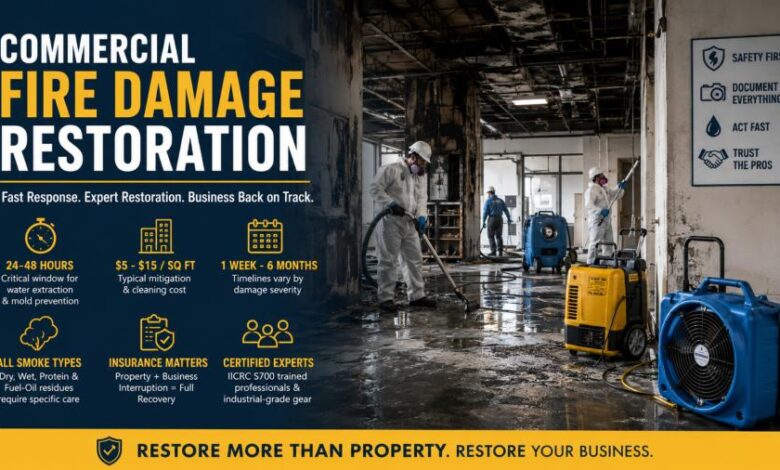
Commercial fire damage restoration is the structured process of stabilizing, cleaning, deodorizing, and rebuilding a business property after a fire — and for most losses it runs roughly $5 to $15 per square foot for the mitigation scope alone, takes anywhere from one week to six months, and is almost never a job an in-house maintenance team should take on. If you are standing in a smoke-filled building right now, the short answer is this: secure the property, call your carrier, and get a certified contractor extracting water within 24 to 48 hours, because that is the window in which mold begins. Everything after that — which residues need which chemistry, what the rebuild will cost, why your business interruption coverage matters more than your property coverage, and where facility crews genuinely can help — is covered below, in the order you will actually need it.
What Commercial Fire Damage Restoration Actually Covers
Commercial fire damage restoration is one continuous workflow that runs from the moment the fire department releases the building to the day a local inspector signs off for reoccupation, and it breaks into three phases that contractors price and schedule separately. Mitigation is the emergency work — board-up, roof tarping, water extraction, containment — and its only job is to stop the loss from getting worse. Restoration is the cleaning phase: HEPA vacuuming, soot removal, contents processing, structural drying, and deodorization. Reconstruction is the rebuild, covering framing, drywall, electrical, mechanical systems, finishes, and the permits and inspections that come with them. Most national firms sell all three as a single turnkey package, largely because the handoffs between separate vendors are where commercial projects stall for weeks. Worth knowing what is not included: the cause-and-origin investigation belongs to the fire marshal and your insurer’s investigator, not your restoration contractor. In a suspected arson or product-liability loss, the scene may be held for several days before anyone can touch anything, and a reputable contractor will document heavily but refuse to disturb evidence until they have written clearance.
Why Commercial Fires Behave Differently From House Fires
The scale difference is obvious; the consequence difference is not. According to U.S. Fire Administration analysis of NFPA and NFIRS data, nonresidential building fires represented only about 8 percent of all fires in the most recent multi-year period published, but they accounted for roughly 20 percent of total dollar loss — an annual average near 108,500 fires and $2.8 billion in property loss. That gap exists because commercial buildings concentrate value in ways homes do not: server racks, refrigeration, production equipment, inventory, tenant improvements, and paper records. Commercial structures also have far more aggressive HVAC systems, which means soot that started in a loading dock can be sitting on ceiling tiles three floors away within minutes of the alarm. Then there is the regulatory layer. A restaurant answers to the health department before it reopens, a medical office answers to infection-control standards, a warehouse answers to fire code on rack storage and sprinkler coverage, and a multi-tenant building answers to every lease it signed. Add the fact that a closed business is still paying rent, payroll, and debt service, and the calculus shifts from “restore the property” to “restore revenue,” which is why commercial jobs are routinely phased so that unaffected areas reopen while work continues elsewhere.
The First 24 to 48 Hours: What Has to Happen Before Cleaning Starts
Nobody cleans anything on day one, and any contractor who starts wiping walls before assessment is a contractor to walk away from. The sequence begins with formal release from the fire department, followed by a structural safety evaluation, because fire weakens steel and engineered lumber in ways that are invisible from the ground, and suppression water adds enormous unplanned load to floors and ceilings. Utilities get locked out — electrical panels stay dead until an electrician verifies them, and gas stays off until the utility clears it. Atmospheric testing comes next, since burned synthetics leave carbon monoxide and hydrogen cyanide behind, and OSHA’s personal protective equipment requirements govern who is allowed in and wearing what. Only then does emergency stabilization happen: board-up on broken openings, tarping on compromised roofing, and temporary fencing on damaged perimeters, all of which also protect your claim by demonstrating you took reasonable steps to prevent further loss. Water extraction runs in parallel and cannot wait, because standing suppression water creates conditions for mold growth inside 24 to 48 hours. Throughout all of it, photograph everything before it moves, and notify your carrier the same day — the restoration clock effectively starts when you call, not when the trucks leave.
Reading the Residue: Dry, Wet, Protein, and Fuel-Oil Smoke
The single most common reason a commercial cleanup fails is that somebody applied the wrong chemistry to the wrong residue, and this is where an experienced technician earns their rate. Dry smoke comes from fast, hot, oxygen-rich fires burning paper, wood, and light furnishings; it leaves a powdery gray-black deposit that responds well to HEPA vacuuming and dry chemical sponges, though the fine particles migrate into cracks and cavities and are harder to fully eliminate than they look. Wet smoke comes from slow, smoldering, low-temperature fires involving plastics and rubber, and it leaves a sticky, oily film that smears the moment anyone touches it with a damp cloth — this category carries the highest risk of turning a cleanable surface into a replacement line item. Protein residue comes from burned organic matter, typically food, and it is close to invisible while producing an intense odor and progressive discoloration of paint and varnish; it requires enzymatic cleaners applied to every surface, including the insides of appliances and cabinetry. Fuel-oil residue from furnace puffbacks is a fourth category with its own solvent pre-conditioning requirement. Technicians identify type on-site using drag tests and pH assessment of ash, and that diagnosis drives the entire scope and price.
The Commercial Fire Damage Restoration Process, Step by Step
Once the building is stable and the residue classified, the work follows a sequence that is deliberately front-loaded with dry methods, because every wet step taken too early creates smearing and cross-contamination that costs days to undo. Containment goes up first — polyethylene barriers and negative air pressure isolate the affected zone so the rest of the facility stays clean and, where possible, operational. HEPA vacuuming removes loose soot from all surfaces, working top to bottom in overlapping straight passes rather than circles. Dry chemical sponges follow on walls and ceilings, lifting residue without water. Only then does wet cleaning begin, matched to residue type: alkaline detergents and degreasers for wet smoke, enzymatic products for protein, solvent systems for fuel oil. Salvageable contents, equipment, and documents are inventoried with barcode tracking and packed out to climate-controlled facilities for off-site processing, which frees the building for reconstruction and protects those assets from ongoing exposure. Structural drying runs continuously with low-grain refrigerant dehumidifiers and air movers, verified by moisture meters rather than by feel. Deodorization comes last, because odor treatment applied before residue removal simply masks a problem that returns. HVAC ductwork is cleaned or replaced, a clearance walkthrough confirms the space is dry, residue-free, and odor-free, and reconstruction begins.
Equipment and Materials Used on a Commercial Loss
The equipment list tells you a great deal about whether a contractor is set up for commercial-scale work, and it is worth asking to see it. Air scrubbers with HEPA filtration and negative air machines handle particulate and pressure differentials across containment zones. Low-grain refrigerant dehumidifiers and high-velocity air movers do the structural drying, sized by cubic footage and monitored with thermo-hygrometers, pin and pinless moisture meters, and thermal imaging cameras that reveal moisture trapped behind finishes. Cleaning materials range from dry chemical sponges and HEPA vacuums to trisodium phosphate solutions, alkaline degreasers, enzymatic cleaners, and abrasive methods such as soda or dry ice blasting for charred structural members. For odor, the two dominant technologies work very differently. Ozone generators oxidize odor molecules quickly but are respiratory irritants; the EPA has stated plainly that no federal agency has approved these devices for use in occupied spaces, and they must run in fully vacated areas, with plants, pets, and sensitive materials such as natural rubber removed beforehand. Hydroxyl generators produce localized radicals that dissipate almost immediately and can generally be operated around staff when manufacturer guidance is followed, which is why they dominate on jobs where a business needs to stay partially open. Units in the 365 to 385 nanometer UVA range are the occupied-space option; some cheaper units use 185 nanometer UVC lamps that generate substantial ozone and are not equivalent.
What Commercial Fire Damage Restoration Costs
Pricing is quoted in two separate buckets, and conflating them is the most common budgeting error business owners make. The mitigation and cleaning scope — soot removal, deodorization, water extraction, contents processing, selective demolition — typically runs $5 to $15 per square foot on commercial losses, with general remediation figures across the wider industry clustering around $4 to $7 per square foot and averaging near $5.50. Reconstruction is priced separately and is where budgets escalate, with rebuild work commonly quoted around $50 per square foot and climbing well past $100 per square foot when a structure needs to come down to the frame. As a whole-project benchmark, commercial contractors describe minor smoke-only jobs starting near $3,000 and extensive losses requiring substantial reconstruction exceeding $100,000, with no meaningful ceiling on large industrial claims. Labor drives 50 to 70 percent of the total, and hourly technician billing commonly falls in the $60 to $150 range per person plus equipment rental, which is why local wage rates move your number as much as damage severity does. All of these figures vary significantly by region, building type, and provider, and they exclude one factor that surprises nearly everyone: the supplement. Insurers scope what is visible, and hidden smoke inside wall cavities or contamination in HVAC systems discovered during demolition generates a supplemental claim that is entirely normal and frequently substantial.
How Long the Work Takes
Timelines in this industry are wide because they are governed less by cleaning speed than by approvals, and honest contractors say so upfront. A minor loss confined to one area with light smoke is typically a one to two week job. Moderate damage involving multiple rooms, meaningful soot travel, and suppression water generally runs four to twelve weeks. A major structural fire affecting multiple floors or requiring engineering assessment routinely takes three to six months, and a total loss requiring ground-up reconstruction follows new-construction schedules of six to twelve months or longer. Emergency stabilization takes hours to a day. Water extraction and initial drying take three to seven days. Cleaning and deodorization span days to several weeks depending on square footage and residue type. Reconstruction is by far the most variable phase, and the delays are rarely on the contractor’s side: permit review backlogs vary enormously by jurisdiction, matching existing finishes may carry long material lead times, and insurance scope disputes or supplemental approvals stall work for weeks. For a commercial client the practical move is phasing — negotiate a scope that reopens the revenue-generating portions of the building first and treats back-of-house reconstruction as a second stage.
Insurance, Business Interruption, and Choosing Your Own Contractor
Property coverage rebuilds the building; it does not replace the income you lost while the building was unusable, and for many businesses the second number is larger than the first. Business interruption coverage, usually an endorsement on a commercial property policy, is what compensates for lost income during the period of restoration, and extra expense coverage funds the temporary location, expedited shipping, or overtime that gets you operating sooner. Both require documentation you should start assembling on day one: prior-year revenue records, payroll, contracts you may fail to fulfill, and a running log of every restoration decision and cost. On contractor selection, insurers maintain preferred vendor programs — networks that have agreed to negotiated rates and standardized protocols in exchange for referral volume. These are recommendations, and in most situations a policyholder retains the right to choose their own licensed contractor, with anti-steering rules in many states reinforcing that. This is genuinely jurisdiction-dependent, however: some policies contain managed repair or right-to-repair provisions that give the carrier more control, and Florida in particular is frequently cited as an exception. Read your policy language and confirm your state’s rules rather than assuming, and consider a licensed public adjuster on large or contested commercial claims, since they represent your interests rather than the carrier’s.
DIY Versus Hiring a Professional: Where the Line Actually Falls
There is a narrow band of legitimate in-house work, and it is smaller than most facility managers assume. If a contained trash-can or appliance fire was extinguished immediately, produced light dry soot in a single room, involved no structural or electrical damage, and left no suppression water, a trained maintenance crew wearing an N95 or half-face respirator, nitrile gloves, and eye protection can reasonably dry-sponge walls, HEPA vacuum, wipe hard surfaces, and ventilate. Everything past that belongs to a certified contractor, and the reasons are practical rather than protective of anyone’s business model. Soot is a respiratory hazard and pre-1980 buildings can release asbestos and lead when disturbed. Charred structural members require load assessment. Fire-exposed wiring can fail intermittently long after it looks fine. Suppression water routinely qualifies as contaminated. Wet and protein residues are actively made worse by untrained cleaning, converting salvageable surfaces into replacements. And critically, undocumented self-performed work gives an adjuster a legitimate reason to dispute scope, since nobody can prove what the pre-cleaning condition was. Never attempt work involving energized systems, gas lines, roof access, structural members, ozone equipment, or industrial chemicals — trisodium phosphate alone is caustic enough to cause chemical burns and requires gloves, eye protection, and ventilation.
Safety Hazards That Persist Long After the Flames Are Out
A cleared building is not a safe building, and the injury statistics in restoration work skew heavily toward hazards people did not expect. Combustion of synthetic materials leaves carbon monoxide and hydrogen cyanide in enclosed spaces, and oxygen-deficient pockets can persist in basements and utility rooms, which is why atmospheric monitoring precedes entry rather than following it. Structural elements lose capacity invisibly: steel that has been heated past its yield point may look intact, and water-saturated ceiling assemblies collapse without warning. Electrical systems that were flooded or heat-damaged present shock and re-ignition risk until an electrician tests and clears each circuit. Airborne soot is a fine particulate with documented respiratory effects, which is why crews use fit-tested respirators rather than dust masks and why containment matters as much for the occupied portions of your building as for the damaged zone. Slip hazards from suppression water combine badly with soot-coated floors. Ozone deserves specific mention: it is a lung irritant even at low concentration and requires a fully vacated, sealed, and clearly signed area, with a defined ventilation period before anyone returns. Any contractor who runs ozone equipment while your staff is in the building is telling you something important about their standards.
Costly Mistakes, Seasonal Factors, and Preventing the Next Loss
The five mistakes that reliably cost businesses money are waiting for an adjuster before starting mitigation, running the HVAC system after a fire and distributing soot building-wide, cleaning wet smoke with dry methods and smearing it into porous surfaces, discarding damaged inventory before it is photographed and inventoried, and hiring on price alone without verifying IICRC credentials. On credentials specifically, the relevant standard is IICRC S700 for fire and smoke damage restoration, with technicians carrying the Fire and Smoke Restoration Technician designation and, on water-heavy losses, Water Damage Restoration Technician or Applied Structural Drying certification; the Restoration Industry Association’s Certified Restorer is a senior credential worth asking about on large commercial claims. Seasonally, a winter fire adds freeze risk to every wet cavity and unheated pipe in the building, and Gulf and Atlantic states see restoration capacity tighten sharply during hurricane season, when crews and equipment get pulled to catastrophe deployments — an important reason to establish a relationship with a contractor before you need one. On prevention, the highest-return items are consistent sprinkler system inspection, testing, and maintenance under the current NFPA 25 requirements, commercial kitchen hood and duct cleaning at frequencies set by NFPA 96 based on cooking volume, annual electrical infrared thermography on panels and switchgear, monthly extinguisher checks, and disciplined housekeeping in storage areas, since storage occupancies account for a meaningful share of nonresidential fires. Verify current code editions with your local authority having jurisdiction, as adopted versions differ by state and municipality.
Also read: What Does Sealing Mean in a Fire Restoration? A Pro’s Complete Guide
Conclusion
Commercial fire damage restoration rewards speed at the front end and patience at the back end, and businesses that recover well tend to get three things right in the first two days: they document everything before anything moves, they get water out of the building inside the 24 to 48 hour mold window, and they hire a properly certified contractor rather than the first truck that shows up. Budget for the mitigation scope and the reconstruction scope as separate numbers, expect a supplemental claim when hidden damage surfaces during demolition, and treat your business interruption coverage as seriously as your property coverage, because for most operations the cost of being closed exceeds the cost of the repairs. The work itself is genuinely technical — the difference between a surface that cleans and a surface that gets replaced often comes down to whether someone correctly identified the residue type in hour one. Ask about IICRC S700 credentials, ask to see the equipment, ask how the project will be phased so parts of your building can reopen early, and get a contractor’s name in your emergency plan before you ever need to dial it.
FAQs
How much does commercial fire damage restoration cost?
Cleaning and mitigation typically run $5 to $15 per square foot, while reconstruction is priced separately. Whole projects range from about $3,000 for minor smoke damage to well over $100,000.
How long does commercial fire restoration take?
Minor smoke damage takes one to two weeks. Moderate losses run four to twelve weeks. Major structural fires typically require three to six months, and total losses often exceed a year.
Does commercial insurance cover fire damage restoration?
Standard commercial property policies generally cover fire damage, but lost income requires separate business interruption coverage. Coverage limits, exclusions, and managed repair provisions vary considerably between policies and states.
Can my maintenance staff clean smoke damage themselves?
Only for light dry soot in a single contained area with no structural, electrical, or water damage. Wet and protein residues smear and worsen when cleaned by untrained people.
Is smoke damage worse than fire damage?
Often yes, in dollar terms. Smoke travels through HVAC systems into areas that never saw flame, and acidic soot corrodes electronics, metals, and finishes if left untreated.
Do I have to use my insurer’s preferred restoration contractor?
Usually no. Most policyholders can select their own licensed contractor, and many states have anti-steering rules. Some policies contain managed repair clauses, so verify your specific policy language.