
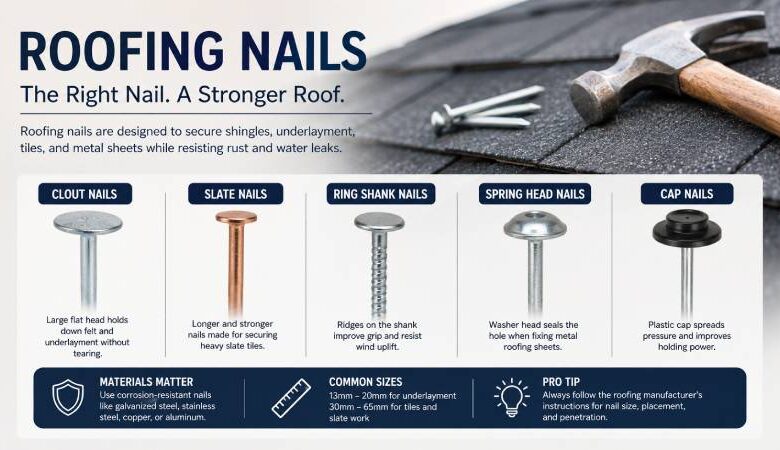
Roofing Nails are specialized fasteners made to hold roofing materials securely to a roof deck while resisting moisture, wind, and corrosion. The right nail depends on the roofing material, deck thickness, required penetration, weather exposure, and manufacturer’s installation instructions.
What Are Roofing Nails and Why Do They Matter?
Roofing nails are typically short, large-head fasteners designed to provide a broad bearing surface without pulling through roofing materials, and they are available with smooth or mechanically deformed shanks and corrosion-resistant finishes. ASTM F1667 specifically includes roofing nails in its driven-fastener specifications, covering characteristics such as dimensions, materials, coatings, and shank configurations. In practical roof work, the nail is only one part of the fastening system: correct placement, adequate penetration, proper driving depth, and compatibility with the roofing product all affect whether shingles or other coverings remain securely attached. For asphalt shingles, manufacturer instructions take priority because fastening patterns and nail requirements can differ between products, roof slopes, and wind conditions.
What Types of Roofing Nails Are Available?
The most useful way to distinguish roofing nails is by their application and shank design. Smooth-shank galvanized nails are common for asphalt shingles and some felt applications because they are easy to drive and widely available; ring-shank nails add mechanical grip through ridges around the shaft and are used where greater holding power is desired; cap nails combine a nail with a larger plastic or metal cap to distribute pressure when fastening certain underlayments; slate and cedar applications may call for specialized corrosion-resistant nails; and metal roofing panels can require fasteners with washers designed to seal the penetration. ASTM F1667 recognizes several roofing-nail configurations, including steel, aluminum-alloy, copper-clad, and zinc-coated designs, showing why “roofing nail” is not one universal specification.
What Size Roofing Nails Do You Need for Shingles?
For conventional asphalt shingles, 1¼-inch nails are a common starting point, but the correct length must be determined from the actual roofing assembly rather than selected by size alone. The nail needs enough length to pass through the shingle and underlying materials and achieve the penetration specified by the shingle manufacturer and applicable code. CertainTeed installation information, for example, specifies at least ¾-inch penetration into decks ¾ inch or thicker for the referenced products, while some reroofing assemblies require longer nails because an additional shingle layer is present. GAF also emphasizes placing nails in the designated nailing area so they engage the intended portions of laminated shingles; simply choosing a longer nail does not compensate for incorrect placement.
How Do Smooth-Shank and Ring-Shank Nails Compare?
Smooth-shank nails are straightforward to install and remain a standard choice for many asphalt-shingle applications, while ring-shank nails have ridges along the shaft that increase resistance to withdrawal. That extra mechanical grip can be valuable where wind uplift is a concern, but it does not mean a ring-shank nail is automatically correct for every roof: the fastener still has to meet the roofing manufacturer’s diameter, length, coating, head-size, and installation requirements. Current retail products illustrate the difference clearly, with common 1-inch and 1¼-inch electro-galvanized smooth-shank nails sold alongside hot-dipped galvanized ring-shank versions intended for roofing applications.
Which Roofing Nail Material Resists Rust Best?
Corrosion resistance matters because roofing fasteners remain exposed to moisture and can eventually compromise the roof covering if they deteriorate. Zinc-coated galvanized steel is widely used for general roofing applications, with hot-dipped galvanizing providing a thicker zinc coating than typical electro-galvanized finishes; stainless steel provides higher corrosion resistance and is commonly selected for demanding environments or compatible specialty roofing systems; copper and copper-clad nails are also used for certain slate and specialty roofing applications. The correct material should be compatible with the roof covering and surrounding metals, particularly on coastal or otherwise aggressive sites. Rather than assuming that every galvanized nail has identical performance, check the roofing manufacturer’s specification and the fastener’s coating designation before buying.
How Many Nails Should You Use Per Shingle?
The required number of nails is determined by the specific shingle, roof slope, wind requirements, local building rules, and manufacturer instructions rather than by a universal rule. Owens Corning states that its Duration shingles use a four-nail fastening pattern for the applicable maximum wind warranty, while six nails are required for slopes exceeding 60 degrees or 21 inches per foot and may also be required by local codes. GAF likewise publishes different fastening requirements depending on its shingle and warranty configuration, including four-nail and six-nail patterns. This is why counting nails on an existing roof is not enough to determine whether it was installed correctly; the fastening location matters just as much as the number.
How Should Roofing Nails Be Installed?
For asphalt shingles, begin by following the exact fastening diagram supplied with the shingles, then use the specified corrosion-resistant nails and place each fastener within the manufacturer’s marked nailing area. Drive nails straight and flush with the shingle surface rather than leaving heads proud or driving them deeply enough to damage the material; Owens Corning specifically warns that improper driving can contribute to corrosion, sealing problems, raised tabs, buckling, and blow-offs. GAF also warns against “high nailing,” where nails are positioned too far toward the upper part of laminated shingles and fail to secure the intended layers. If a nail is badly misplaced, overdriven, or crooked, do not simply ignore it because the head appears covered; correct the fastening according to the product instructions.
How Much Do Roofing Nails Cost?
Roofing nail prices vary substantially by length, coating, shank style, material, packaging, and whether the nails are hand-driven or collated for a pneumatic nailer. Current U.S. retail examples show 1-inch electro-galvanized roofing nails around $5.99–$6.48 for a 1-pound box, while 1¼-inch examples are around $6.48; specialized 1¾-inch hot-dipped galvanized ring-shank nails with washers can be around $7.98–$9.77 per pound, and larger professional quantities can range from roughly $21 for 5 pounds to about $53 for 30 pounds. Collated coil roofing nails cost more upfront but are sold in much larger quantities, with current examples ranging from roughly $80 to $146 per box. These are product prices rather than installed-roof costs, and local stores, brands, taxes, shipping, and availability can change the final price.
What Tools Do You Need, and When Should You Hire a Roofer?
Small, accessible roofing repairs may require only the specified nails, a roofing hammer, pry bar, utility knife, measuring tools, and compatible roofing materials, while full installations commonly use pneumatic or other powered roofing nailers with the correct collated fasteners. The difficult part is not driving the nail; it is safely accessing the roof and maintaining correct fastening patterns across the entire installation. OSHA states that residential construction workers six feet or more above a lower level generally require conventional fall protection or another permitted protective measure, and roofing work introduces additional hazards from slopes, edges, fragile materials, tools, and weather. For a steep, high, wet, damaged, or unfamiliar roof—or a full replacement—a qualified roofing professional is the safer choice.
Common Roofing Nail Mistakes to Avoid
The most costly mistakes are usually simple ones: choosing a nail that is too short for the roof assembly, using a fastener with inadequate corrosion resistance, placing nails outside the manufacturer’s fastening zone, underdriving or overdriving the head, relying on an old nail hole when a new fastening location is required, or assuming that more nails automatically make an installation better. Another common mistake is using the same fastener for every roofing material; a nail suitable for asphalt shingles may not be appropriate for slate, cedar, underlayment, or metal panels. Before starting, match the fastener to the roofing product, verify the required length and penetration, check the nailer’s compatibility if using power tools, and follow the current installation instructions supplied by the roofing manufacturer.
Conclusion
Choosing roofing fasteners correctly is less about finding the longest or strongest-looking nail and more about matching the fastener to the roofing system. Check the shingle or roofing manufacturer’s instructions first, then confirm the required length, head diameter, shank style, corrosion resistance, nail placement, and fastening pattern. For many asphalt-shingle installations, 1¼-inch galvanized nails are a common starting point, but that should never replace the product-specific specification. A few dollars saved by using the wrong fastener can be insignificant compared with the labor and damage involved in correcting a failed roof, so the safest approach is to use the specified fastener and have a professional handle roof work when height, slope, structural damage, or fall hazards make DIY installation unsafe.
Also read: Roofing Cop Explained: What It Means, Real Costs, and How to Fix It
FAQs
What size nails are best for asphalt shingles?
A 1¼-inch nail is common for many asphalt-shingle installations, but required length depends on deck thickness, roofing layers, slope, and manufacturer specifications.
Are ring-shank nails better for roofing?
Ring-shank nails provide greater withdrawal resistance than smooth shanks, but they are only better when their size, coating, and type match the roofing system.
Can I use regular nails for roofing?
Ordinary nails are not automatically suitable; roofing fasteners need appropriate heads, dimensions, corrosion resistance, and compatibility with the roofing material and manufacturer.
How many nails are needed per shingle?
Four nails per shingle is common for many asphalt-shingle systems, while six may be required for steep slopes, high-wind conditions, codes, or warranties.
Should roofing nails go through the roof deck?
Nails must achieve the penetration specified for the roofing assembly; requirements vary, so excessive or insufficient penetration should both be avoided.
Can roofing nails rust and cause leaks?
Yes, corrosion can weaken fasteners and contribute to roofing problems, which is why manufacturers specify corrosion-resistant nails appropriate for the exposure and roofing material.