
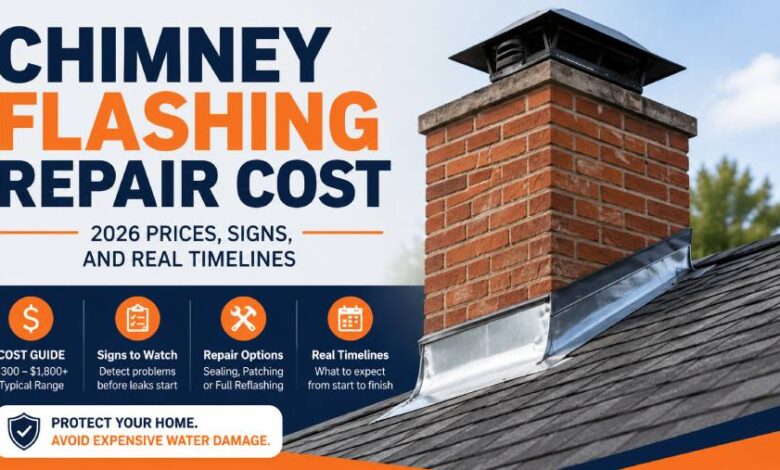
Chimney flashing repair cost typically falls between $300 and $1,800 for most American homes in 2026, with minor resealing jobs starting around $200 and full replacements on oversized chimneys climbing past $2,000. The reason the range is so wide has almost nothing to do with the metal itself flashing materials for a standard single-flue chimney run only about $70 to $100 and almost everything to do with labor, chimney size, roof access, and whether water has already found its way into the roof deck below. This guide breaks down what drives each dollar of that estimate, how to read the warning signs before the ceiling stains appear, what a correct reflashing job actually involves, and where homeowners consistently waste money trying to shortcut a repair that only works when it’s done in the right order.
What Chimney Flashing Is and Why It Fails
Chimney flashing is not one piece of metal but a layered system of overlapping components that seal the joint where masonry meets roofing: an apron at the downhill base, step flashing woven up each side one shingle course at a time, counter-flashing tucked into a groove cut in the mortar joint, and on wider chimneys a cricket or saddle behind the uphill wall. Each layer handles a different water path, and the system only works when all of them overlap correctly. Failure is usually predictable rather than random masonry and sheet metal expand and contract at different rates, so decades of thermal cycling loosen counter-flashing from its mortar bed, freeze-thaw cycles crack the sealant, galvanized steel eventually corrodes through, and debris piled against the uphill side lets water pool where it was never meant to sit. Well-installed metal flashing generally lasts 20 to 30 years, though harsh winters, coastal salt air, and roofs that go unmaintained shorten that considerably.
Chimney Flashing Repair Cost in 2026: The Short Answer
For a straightforward number to budget against, most homeowners pay $300 to $1,800 for chimney flashing repair, with a national midpoint closer to $400 to $800 for a standard single-flue chimney roughly three feet square on an accessible single-story roof. Independent cost trackers land in overlapping territory: some report a $400 to $1,600 typical band, others $325 to $1,400 for a full single-chimney replacement, and a common breakdown puts materials at $100 to $700 against labor of $200 to $1,500. That labor share is the important detail skilled labor accounts for roughly 60 to 70 percent of a typical bill, which is why two houses on the same street can receive quotes that differ by several hundred dollars based on nothing more than roof pitch and how the crew has to reach the chimney. Prices vary meaningfully by region and by contractor, so treat any published figure as a sanity check on your quotes rather than a fixed price.
Cost by Repair Type: Sealing, Patching, and Full Reflashing
The single biggest question a contractor answers on the first visit is whether your flashing can be salvaged or has to come out entirely, and the answer moves the price more than any other factor. Minor work resealing a lifted edge, re-embedding a section of counter-flashing that has pulled out of the mortar, or patching a short run of corroded step flashing generally runs $200 to $500 and is finished in one to three hours. Repointing the reglet and resealing the perimeter without replacing metal often lands in the $300 to $800 band. Full reflashing, where every component is stripped out and rebuilt, is where costs jump: expect roughly $400 to $800 on a standard chimney, $1,200 to $2,000 on oversized stacks measuring five feet square or larger, and up to $2,200 when a cricket is required or the surrounding shingles need replacing. Related work often gets bundled in, since chimney sealing runs $150 to $400, full waterproofing can reach $850, and crown repair adds $200 to $700 when the mason is already up there.
How Flashing Material Affects What You Pay
Material choice matters for lifespan far more than for budget, which surprises homeowners who assume upgrading to copper will double the bill. On a per-linear-foot basis, galvanized steel is the cheapest at roughly $0.50, aluminum sits near $0.75, and copper runs $2 to $3 real differences, but on a chimney with a twelve-foot perimeter, they translate to a swing of only $200 to $600 across the full job once labor is included. Aluminum has become the default residential choice in 2026 because it does not rust, bends easily for custom work, and holds up for decades with minimal attention. Galvanized steel is serviceable but can corrode through in 10 to 15 years, particularly in coastal or acidic environments, and it benefits from painting. Copper is the premium option, lasting 50 or more years and developing its characteristic patina, and it is the standard specification on slate, tile, and historic roofs with one non-negotiable rule: copper must never contact galvanized metal on the same roof, because galvanic corrosion will destroy the joint.
Chimney Size, Roof Access, and Regional Labor Rates
Access is the hidden multiplier that turns a routine job into an expensive one, and it is the factor homeowners most often forget to ask about. A single-story chimney a crew can reach from a standard extension ladder costs the least; contractors commonly apply a labor multiplier of roughly 1.2 times for two-story homes and 1.45 times for three stories or higher, and steep pitches, tile roofs, and blocked rear elevations push that further. Chimney dimensions scale the work directly, since a larger perimeter means more step flashing pieces, more counter-flashing, and more reglet to cut a twelve-foot perimeter needs roughly 29 pieces of step flashing at standard five-inch shingle exposure. Any chimney wider than 30 inches on the slope side of a roof requires a cricket under the International Residential Code, which typically adds around $380 to the job. Regional labor rates layer on top: masons and chimney professionals charge $50 to $125 per hour on average, with urban markets running well above rural ones, and some jurisdictions require a permit and inspection that adds fees.
Warning Signs Your Chimney Flashing Is Leaking
Catching flashing failure early is the difference between a $400 repair and a four-figure restoration, and the useful signs appear long before water reaches a ceiling. From the ground with binoculars, look for metal that has lifted or curled away from the brick, rust streaks running down the masonry, visible gaps at the mortar joint where counter-flashing should be seated, and old tar or caulk smeared over the joint by a previous owner. In the attic, check the underside of the roof deck around the chimney chase after heavy rain for damp sheathing, dark staining, rusted nail heads, or compressed and discolored insulation. Inside the living space, brown ceiling stains near the chimney, peeling paint on an adjacent wall, a musty smell in an upstairs room, or efflorescence the white powdery salt deposit on interior chimney brick all indicate water has been moving for some time. Staining that darkens after every storm and dries between them is the classic flashing signature rather than a masonry problem.
What a Proper Reflashing Job Involves and How Long It Takes
Understanding the actual sequence helps you judge whether a quote reflects real work or a cosmetic pass. A correct job starts with removing several courses of shingles around the chimney so new step flashing can be woven into the roofing one course at a time, because retrofitting flashing on top of existing shingles without reweaving is almost always a failure. The crew then cuts a reglet into the mortar joint with a grinder roughly 30 minutes per side on sound masonry seats the counter-flashing into that groove, and points it with compatible mortar or sealant so the metal can move without tearing. An apron goes in at the base, a cricket is built behind the uphill wall if the chimney exceeds 30 inches, and shingles are reinstalled over the flashing so water always flows onto metal rather than under it. Most single-chimney jobs are completed in a half day to a full day, with minor patches taking one to three hours, and poor mortar condition requiring tuckpointing can add two to six hours of mason labor.
DIY vs. Hiring a Professional
The materials are genuinely inexpensive a galvanized flashing kit for a 32-inch single-flue chimney runs $70 to $100, and forming your own from coil stock requires a sheet metal brake that rents for roughly $60 to $70 per day which makes DIY look attractive on paper and explains why so many homeowners attempt it. In practice, flashing is one of the least forgiving roofing tasks for a non-professional, for three specific reasons: step flashing must be integrated into the shingle courses in the correct sequence, counter-flashing must be properly embedded in masonry rather than surface-mounted, and every overlap must shed water in the right direction. Get any of those wrong and the roof leaks invisibly from above while actively damaging the deck below, often for a year or more before it shows. Sealing the joint with roofing cement or caulk is the most common DIY approach and the least durable; it typically fails within months because it addresses none of the underlying geometry and can trap moisture against the sheathing. If you own the tools, have safe roof access, and understand shingle sequencing, a small patch is reasonable; a full reflash is not.
Safety Precautions Before Anyone Goes on the Roof
Roof work causes serious falls every year, and chimney flashing sits at the steepest, most awkward part of most roofs, so treat access as the first decision rather than an afterthought. Never work on a wet, frosted, or moss-covered surface, avoid windy days entirely, and set ladders on firm level ground at roughly a four-to-one angle with at least three feet extending above the eave and the top secured. Fall protection is not optional above six feet under federal workplace standards, and a harness anchored to a properly installed roof anchor is the minimum for anyone spending more than a few minutes up there. Inspect the flue for blockages and make certain the fireplace has been cold for at least 24 hours before anyone works around the crown, since residual heat and carbon monoxide are real hazards. If your chimney is on a second or third story, on a pitch steeper than about 6:12, or on tile or slate that cracks underfoot, the honest answer is to hire a crew with proper staging most homeowner injuries in this category come from access, not from the repair itself.
Common Mistakes That Turn a Small Repair Into a Big One
The most expensive errors in this category are almost all sequencing and diagnosis mistakes rather than material ones. Layering fresh caulk or roofing tar over failing flashing is the leading offender: it hides the symptom, holds moisture against the metal and masonry, and lets rot progress in the sheathing while the homeowner believes the problem is solved. Accepting a quote before confirming access method is another some contractors add staging or scaffolding charges after the job has started when it was not agreed in writing. Mixing incompatible metals, particularly copper against galvanized steel, guarantees corrosion at the joint. Reusing old counter-flashing on a chimney that needs repointing means the new mortar work will simply dislodge it again. Skipping a cricket on a wide chimney creates chronic uphill leaking that no amount of sealant fixes. And treating chimney flashing repair cost as the whole picture while ignoring a cracked crown or spalled brick above it means water keeps entering from a different route within a year or two.
Does Homeowners Insurance Cover Chimney Flashing Repair?
Coverage hinges almost entirely on cause, and this is where many claims are denied. Standard homeowners policies cover sudden, accidental damage from a defined event a windstorm ripping flashing loose, hail impact, a falling tree limb along with the resulting interior water damage, minus your deductible and any depreciation. What they generally exclude is gradual deterioration: rusted flashing, cracked sealant, loose counter-flashing, aging shingles, and slow seepage attributed to wear, age, poor original installation, or deferred maintenance. Insurers treat flashing as a maintenance-sensitive component, so adjusters look closely at timing and evidence. If a storm caused your leak, report it promptly, photograph the chimney, roof slopes, attic staining, and any storm debris, keep receipts for temporary mitigation like tarping, and request a written cause opinion from the roofer. Long-delayed reporting, long-term staining, and a history of repeated caulk patches are the patterns most likely to result in a denial. Policies differ, so read your own coverage rather than relying on general summaries.
Maintenance, Inspection Frequency, and Seasonal Timing
Preventive attention is dramatically cheaper than reactive repair, and the interval that works for most homes is straightforward: have the chimney and flashing inspected annually, ideally in early fall before heating season and before winter weather makes roof work risky and expensive. A basic visual chimney inspection costs $100 to $300 for a simple structure and up to $600 for complex or damaged ones, while a camera-based Level 2 inspection runs $200 to $500 and is worth booking before committing to any significant repair so you only pay to fix what is actually failing. Between inspections, clear leaves and debris from the roof valleys and the uphill side of the chimney, check ceilings for new stains after major storms, and re-examine the flashing after high winds and after the first hard freeze-thaw swings of spring. Late spring through early fall is the practical window for the work itself, since sealants and mortar cure poorly in cold weather and emergency winter service carries a premium.
Conclusion
Chimney flashing repair cost is one of the few home maintenance figures where acting early genuinely changes the number by an order of magnitude, because the $200 to $500 you spend resealing a lifted edge prevents the rotted sheathing, saturated insulation, and interior restoration that follow a leak left running through a single winter. Get a written quote that names the repair scope, the flashing material, the access method, and whether a cricket or tuckpointing is included, and be skeptical of any estimate that proposes sealing over existing metal as a lasting solution. Prices in this guide reflect 2026 national averages and will vary by region, roof configuration, and contractor, so compare two or three local quotes against these ranges rather than treating any single number as fixed. If water is actively entering your home, the inspection is the urgent step everything else follows from knowing exactly which layer failed.
Also read: Average Cost of Chimney Cleaning in the UK: Complete 2026 Price Guide
FAQs
How much does chimney flashing repair cost on average?
Most homeowners pay $300 to $1,800, with a typical single-flue chimney landing near $400 to $800. Minor resealing starts around $200; oversized chimneys can exceed $2,000.
Can I repair chimney flashing myself?
Small patches are possible if you have safe access and understand shingle sequencing. Full reflashing is not a realistic DIY job, because step flashing must be woven into shingle courses.
How long does chimney flashing last?
Quality metal flashing typically lasts 20 to 30 years. Galvanized steel may corrode in 10 to 15 years, while copper commonly exceeds 50 years with minimal maintenance.
Is caulking chimney flashing a permanent fix?
No. Caulk and roofing cement usually fail within months because they address no underlying geometry, trap moisture against metal and masonry, and often accelerate hidden deterioration below.
Does a chimney need a cricket?
Yes, if it exceeds 30 inches wide on the roof’s slope side, per the International Residential Code. A cricket typically adds around $380 to the job.
How long does chimney flashing replacement take?
Most single-chimney jobs finish in a half day to a full day. Minor patches take one to three hours; poor mortar requiring tuckpointing adds several hours.