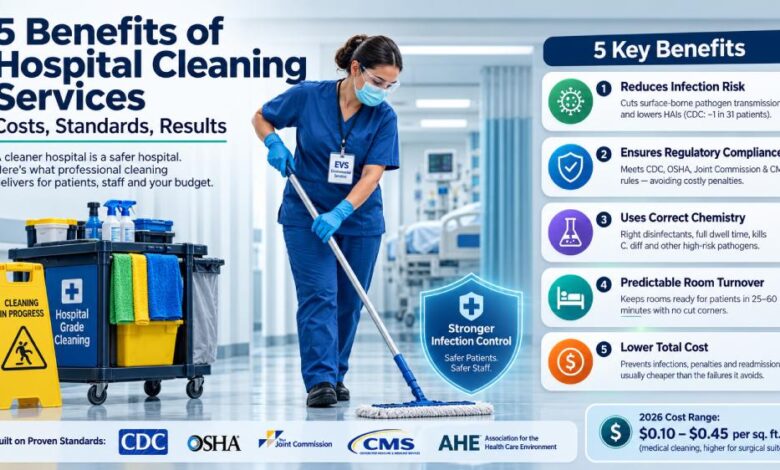
5 benefits of hospital cleaning services come down to one thing a facility manager can measure: whether the environment stops transmitting pathogens between patients, and whether you can prove it to a surveyor. Specialized healthcare cleaning reduces surface-borne infection risk, keeps you compliant with rules that carry direct financial penalties, enforces disinfectant chemistry that general janitorial crews get wrong, makes room turnover predictable, and usually costs less than the failures it prevents. What follows is a working breakdown — real cost ranges, real time requirements per room, the certifications worth asking about, the safety rules that are non-negotiable around hospital-grade chemicals, and an honest note about which industry statistics do not hold up when you check the source.
What Hospital Cleaning Services Are and How They Differ From Standard Janitorial Work
Hospital cleaning — properly called environmental services, or EVS — covers the same baseline tasks as any commercial contract (floor care, restrooms, trash, waiting areas, high-touch wiping) and then adds an entire second layer that has nothing to do with appearance. That second layer is where medical cleaning separates from standard janitorial service, and it comes down to compliance training, specialized equipment, and frequency. The practical differences show up in small operational details a general crew has never been taught: separate color-coded cloths and mop heads for isolation rooms versus reception areas so nothing crosses zones, disinfectant products matched to the specific organism rather than whatever is on the supply shelf, biohazard waste streams kept distinct from general refuse, HIPAA awareness because technicians work in rooms containing patient information, and a written record of every clean that can be produced on demand. The physical environment is a documented contributor to infection when cleaning protocols fail, which is why the work is structured around verification rather than visual inspection. A room can look immaculate and still be a transmission risk, and that gap is the entire reason healthcare-specific cleaning exists as its own trade.
Benefit 1: A Measurable Reduction in Surface-Borne Infection Risk
The headline benefit is infection control, and the evidence supports it — with more nuance than most vendor pages admit. The CDC estimates roughly 1 in 31 hospital patients has a healthcare-associated infection on any given day, and an estimated 20% of HAIs originate from contaminated environmental surfaces, with high-touch items in the patient room — bedrails, over-bed tables, call buttons — and shared reusable equipment acting as documented transmission routes. Field data shows what good technique achieves and where it breaks down: a three-hospital U.S. study found terminal cleaning reduced target pathogens by more than 99% at two of the three sites, but at the third, MRSA fell only 73% on nurse call buttons and VRE actually increased on some surfaces. Technique, not the mere presence of a cleaner, produces the result. One ICU intervention makes the point cleanly: after staff were trained to use four colors of disposable wipes for bedside, high-risk, paperwork, and public zones, verified-clean high-touch surfaces rose from 13% to 53%, and HAI density dropped from roughly 14.3 per 1,000 at baseline to 9.1 per 1,000 in the follow-up period. That is the mechanism worth paying for.
Benefit 2: Compliance With Rules That Carry Real Financial Penalties
The second of the 5 benefits of hospital cleaning services is regulatory, and in the United States the exposure is layered across four separate authorities. Facilities must satisfy CDC environmental infection control guidance, OSHA’s Bloodborne Pathogen Standard at 29 CFR 1910.1030, Joint Commission Environment of Care standards including EC.02.06.01, and CMS Conditions of Participation for Medicare and Medicaid certified sites. Falling short can produce Joint Commission deficiencies, CMS citations, OSHA penalties, and increased insurance liability. The money is direct: CMS’s Hospital-Acquired Condition Reduction Program applies a 1% Medicare payment reduction to hospitals in the worst-performing quartile, and Joint Commission’s 2024 standards updates shifted survey focus from paperwork toward on-the-ground implementation. UK readers face a parallel framework — the National Standards of Healthcare Cleanliness 2025 replaced the 2021 version, apply to all NHS trust settings regardless of how cleaning is delivered, and meeting aspects of them is mandatory. The 2025 edition introduced six risk categories, revised cleaning frequencies, mandatory efficacy audits, and extended scope to ambulance services. A competent contractor arrives already carrying the audit trail those regimes demand rather than assembling it the week before a survey.
Benefit 3: Correct Chemistry and Full Dwell Time on Every Surface
This is the benefit almost nobody sells and every infection preventionist cares about. Cleaning must always precede disinfection — applying germicide to soiled surfaces is one of the most common and preventable failure points — and disinfectant selection must match both the surface and the pathogen, because standard quaternary ammonium products cannot kill C. difficile spores. The single most common terminal cleaning failure is not a missed surface but rushing past dwell time: every EPA-registered disinfectant has a label-specified wet time, and spraying a surface then wiping it dry ten seconds later means you have cleaned it without disinfecting it. A quat may need one to five minutes against common bacteria and viruses, while a sporicidal product for C. diff often requires a bleach-based or accelerated hydrogen peroxide active ingredient held wet for longer. In operating rooms, crews are trained to apply enough product to keep surfaces wet for the manufacturer’s full duration, frequently between 3 and 10 minutes, wiping in one direction rather than circles and switching cloth faces often. Porous items like fabric privacy curtains cannot be disinfected by wiping at all, making them an underestimated ongoing risk.
Benefit 4: Predictable Room Turnover Without Cut Corners
Bed availability is a revenue and safety issue simultaneously, and a trained EVS program gives you a turnover time you can actually schedule against. The Association for the Health Care Environment has reaffirmed that following all recommended practice steps, cleaning an occupied patient room takes approximately 25 to 30 minutes. For post-discharge work, a standard patient room terminal clean typically runs 30 to 45 minutes for a two-person crew, while an operating room or isolation room with added precautions can take 45 to 90 minutes depending on contamination level and whether sporicidal dwell times apply. Other operators report an average of 30 to 60 minutes per room, longer for high-risk or isolation spaces. The reason those numbers matter is that pressure compresses them. Industry commentary has flagged the risk of managers letting staff process in 10 minutes what a facility-specific checklist says should take 40, and of choosing three-minute dwell products purely to shorten time in the room without training staff on keeping surfaces wet long enough to reach that dwell. A contract written around verified task time rather than a headcount protects you from that compression.
Benefit 5: A Lower Total Cost Than Most Facilities Expect
Cost is where the 5 benefits of hospital cleaning services argument is most often overstated, so here is what the evidence actually supports. AHRQ estimates HAIs cost the U.S. healthcare system between $28 billion and $33 billion annually in excess costs. The strongest economic finding comes from a multi-centre trial rather than a vendor brochure: the REACH study found an 86% probability that implementing a structured cleaning bundle was cost-effective compared with existing hospital cleaning practice, at an incremental cost-effectiveness ratio of $4,684 per quality-adjusted life year, with reduced HAI rates also cutting patient bed days and antibiotic use. Note carefully what that does and does not say — it supports investing in better cleaning, not the blanket claim that outsourcing is inherently cheaper than an in-house department. There is no reliable public dataset showing contracted EVS costs less than direct employment, and NHS England explicitly declines to specify whether cleaning should be delivered by direct employment or contracting out, treating it as a local decision. The defensible framing is that a properly resourced program pays for itself against avoided infections, avoided reimbursement penalties, and avoided survey findings.
What Hospital Cleaning Services Cost in 2026
Pricing follows two common structures — per square foot per visit, or hourly per technician — and medical work sits meaningfully above general commercial rates because of training, chemistry, and documentation. Aggregated 2026 figures put medical office cleaning at roughly $0.10 to $0.35 per square foot for routine service versus $0.05 to $0.20 for standard office space, with hourly rates from $25 to $80 and most practices paying $50 to $60 per hour for a trained, compliant team; small-to-midsize practices commonly spend $500 to $3,000 per month. One Southeast U.S. operator publishes 2026 medical ranges of $0.18 to $0.30 per square foot against $0.12 to $0.18 for offices. High-acuity space costs more: a San Diego provider reports surgery centers and outpatient specialty practices at $0.40 to $0.45 per square foot or above, with hourly billing reaching $150 to $175, and notes these sit higher than national benchmarks that often quote $0.25 to $0.35. Treat all of these as market estimates, not fixed rates — the underlying figures come from self-reported cleaning-professional and customer data and are averages rather than regulated benchmarks. Costs vary substantially by state, labor market, floor surface mix, restroom count, and service frequency, so insist on a walkthrough-based quote rather than a blueprint estimate.
Warning Signs Your Current Cleaning Program Is Failing
You rarely get a dramatic failure; you get drift, and it shows up in specific, checkable places. Watch for turnover times that have quietly shortened without any change in method — if terminal cleans that should take 30 to 45 minutes are being logged at 12, dwell time is not being met, full stop. Look for a single all-purpose disinfectant used facility-wide, which guarantees inadequate treatment of C. diff rooms given that quats do not kill spores. Check whether cloths and mop heads are visibly separated by zone or whether one bucket services isolation and reception alike. Ask when privacy curtains were last changed rather than wiped, and whether anyone tracks it. Audit the paperwork honestly: if your compliance records are handwritten sheets completed retrospectively rather than logged per room, a surveyor focused on implementation rather than documentation will find the gap. Also watch for scope gaps, where a vendor either quotes less than the facility requires and the building degrades over time, or bills quarterly tasks as though they occur monthly. Rising HAI rates in specific units, with no clinical explanation, deserve an environmental audit before anything else.
The Equipment, Chemicals, and Time the Job Actually Requires
A properly equipped healthcare crew carries materially different kit from an office team. The CDC recommends EPA-registered hospital-grade disinfectants drawn from specific EPA lists, including List N for SARS-CoV-2 and lists covering emerging pathogens. A working setup includes at least two disinfectant chemistries — a quat or similar for routine surfaces and a sporicidal agent for C. diff rooms — plus microfiber cloths in a color-coded system, dedicated microfiber mop heads changed per room rather than per corridor, sealed biohazard waste containers, sharps containers, and full PPE including gloves, eye protection, and gowns for isolation work. Many facilities add no-touch adjuncts such as UV-C light or hydrogen peroxide vapor on top of manual cleaning, not instead of it. Method matters as much as materials: work ceiling to walls to floors, edges toward the center where contamination concentrates, in a consistent rotational direction so nothing is missed, and remove linens folded into a bundle without shaking to avoid aerosolizing pathogens. Budget realistically for the time this takes and for consumable volume, because underestimating cloth and wipe consumption is the fastest route to crews reusing contaminated materials across rooms.
Safety Precautions That Are Not Optional
Healthcare cleaning involves concentrated chemicals, biological hazards, and sharps, so treat safety as a hard requirement rather than a training slide. Never mix disinfectant products — combining bleach-based sporicidals with ammonia-containing or acidic cleaners can release chlorine or chloramine gas, and this is the most common serious injury in the trade. Every product on site needs a current Safety Data Sheet accessible to staff, correct dilution per label rather than by eye, and manufacturer-specified PPE worn every time, not just during isolation cleans. Employers are legally required to plan for bodily fluid spills, including procedures for cleanup and disposal of contaminated waste, to assess employees’ risk of contact and implement controls, and to take precautions preventing staff from suffering puncture wounds, cuts, and abrasions — with approved sharps containers available. Any staff member handling a spillage must have received the specific training for that spillage type and follow the method statement completely. Add practical hazards to the list: wet-floor signage during mopping, and proper stepladder use for vents, light fixtures, and overhead surfaces during terminal cleans. Never let untrained staff handle sharps or unknown spills.
In-House EVS Versus a Contracted Provider
There is no universally correct answer here, and anyone telling you otherwise is selling something. In-house departments give you direct control over training, hiring standards, and culture, and they tend to produce lower turnover among technicians who identify as part of the clinical team — which matters because technique consistency is the variable that drives outcomes. Contracted providers give you scale, surge capacity, pre-built compliance documentation systems, existing certification pipelines, and a single accountable party when standards slip. Environmental services are essential to infection control, and because disinfection services are frequently outsourced, hospital managers carry responsibility for ensuring infection control procedures are implemented and effective regardless of who performs the work. That is the key point: outsourcing transfers labor, not accountability. The regulatory position reinforces this — NHS England’s standards apply to all trust settings regardless of how cleaning services are provided, and leave the employment model to local determination. Decide on the basis of your ability to supervise. If you have an EVS director with real infection-control fluency, in-house often wins. If you do not, a certified contractor with documented protocols is the safer path.
Common Mistakes and How to Vet a Provider Before You Sign
The recurring mistakes are predictable: buying on price per square foot alone, accepting a quote produced from blueprints instead of a walkthrough, failing to specify sporicidal chemistry for C. diff rooms in the scope of work, and writing contracts around headcount rather than verified task completion. One useful diagnostic is labor cost percentage — a janitorial business running below roughly 45% labor cost is almost certainly cutting supervision, training, or equipment maintenance, while above 70% it is losing money and will either renegotiate from leverage at renewal or quietly reduce hours. When vetting, ask for specific credentials rather than general assurances. The Association for the Health Care Environment offers the Certified Health Care Environmental Services Technician (CHEST) and Certified Surgical Cleaning Technician (CSCT) credentials for frontline staff, plus CHESP for professionals. CSCT requires six months of healthcare EVS experience, 24 hours of training delivered by a designated trainer, and a 50-question exam. On the organizational side, ISSA administers the Cleaning Industry Management Standard (CIMS) Advanced by GBAC and the GBAC STAR program. Also require electronic audit logging, defined dwell-time protocols in writing, and named escalation contacts.
Conclusion
The 5 benefits of hospital cleaning services hold up under scrutiny, but only when the program itself is built properly — trained technicians, pathogen-matched chemistry, honored dwell times, zone-separated equipment, and audit records that survive a surveyor’s attention. Strip any one of those out and you are paying medical rates for office-grade work, which is the worst outcome available. Before you renew or replace a contract, walk a terminal clean end to end with a stopwatch, check what disinfectant is being used in your C. diff rooms, and ask to see last month’s audit logs. Those three checks will tell you more about your infection-control exposure than any proposal document, and they cost nothing but an hour of your time.
FAQs
What is included in hospital cleaning services?
Routine floor care, restroom sanitation, trash and biohazard waste handling, high-touch surface disinfection, isolation room protocols, terminal cleaning after discharge, and documented audit records for compliance surveys.
How often should a hospital be professionally cleaned?
Patient care areas need daily cleaning at minimum, with high-touch surfaces disinfected multiple times per shift. Terminal cleaning follows every discharge, transfer, or completed isolation precaution period.
How much do hospital cleaning services cost per square foot?
Aggregated 2026 pricing data puts medical cleaning around $0.10 to $0.35 per square foot, with surgical and specialty suites reaching $0.40 or higher in expensive markets.
What is the difference between terminal cleaning and daily cleaning?
Daily cleaning happens while a room is occupied and targets visible soil and high-touch points. Terminal cleaning is a full ceiling-to-floor decontamination performed after the patient leaves.
Do hospital cleaners need special certification?
Certification is not universally mandated, but AHE credentials like CHEST and CSCT, plus ISSA’s CIMS and GBAC programs, are the recognized benchmarks buyers should request.
Can regular commercial cleaners clean a medical facility?
Generally no. Office crews rarely carry bloodborne pathogen training, sporicidal chemistry, color-coded equipment systems, or the documentation that Joint Commission and CMS surveyors expect to see.