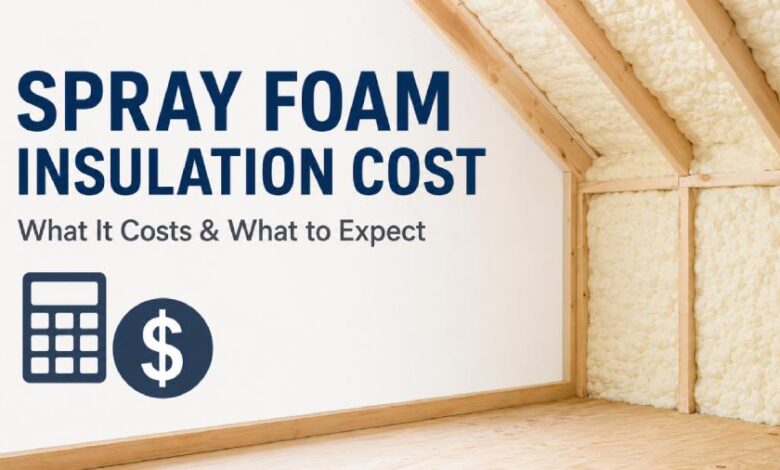
Spray foam insulation cost typically falls around £20–£50 per square metre in the UK, while current US pricing commonly works out to about $1–$5 per square foot installed, depending on foam type, thickness, access, project size, and labor. For homeowners, the price per area is only the starting point: a loft, crawl space, wall cavity, or roof can require very different preparation and application methods. This guide explains what you can realistically expect to pay, how open-cell and closed-cell foam differ, what affects the final quote, and when professional installation makes more sense than attempting the work yourself.
How Much Does Spray Foam Insulation Cost?
The cost of spray foam insulation depends mainly on the area being treated, the foam selected, the thickness required, and the difficulty of reaching the surface. In the UK, current published 2026 pricing places professional installation at roughly £20–£50 per m², with open-cell foam generally starting around £20 per m² and closed-cell foam around £35 per m². In the US, current consumer cost data puts spray foam at approximately $1–$5 per square foot installed, although another common pricing method is the board foot, which combines one square foot of coverage with one inch of thickness. Angi currently reports installed pricing of about $0.60–$1.60 per board foot for open-cell and $1.30–$3.10 for closed-cell.
Spray Foam Insulation Cost Per Square Foot
Spray foam insulation cost per square foot varies substantially between countries because labor rates, building practices, taxes, product specifications, and quoting methods differ. Using the UK range of £20–£50 per m², the equivalent is approximately £1.86–£4.64 per square foot, before considering any unusual preparation or access costs. US sources commonly quote approximately $1–$5 per square foot for installed spray foam, while board-foot pricing is also widely used because insulation thickness directly affects material consumption. This distinction matters when comparing quotes: a contractor offering a price per square foot may not be quoting the same thickness or specification as another contractor using a board-foot rate, so always ask what thickness and foam type are included.
Open-Cell vs. Closed-Cell Spray Foam
Open-cell and closed-cell spray foam are not simply cheaper and more expensive versions of the same product; they have different physical characteristics and are suited to different applications. Open-cell foam is softer, less dense, expands more, and generally costs less, with current US installed pricing around $0.60–$1.60 per board foot. Closed-cell foam is denser and rigid, provides a higher R-value per inch, and offers greater resistance to moisture, with current installed pricing around $1.30–$3.10 per board foot in US cost data. Angi reports approximately R-3.5–R-3.7 per inch for open-cell and R-5–R-7 per inch for closed-cell, although the exact performance depends on the specific product. The correct choice should therefore be based on the building assembly and moisture conditions rather than price alone.
What Affects the Cost of Spray Foam Insulation?
The final quotation can be considerably different from a simple area calculation because contractors have to account for more than the foam itself. The size of the job affects material and labor efficiency, while difficult roof spaces, restricted crawl spaces, high ceilings, awkward corners, or limited access can increase installation time. Thickness also matters because more foam means more material and potentially additional application passes. Existing insulation may need removal, surfaces may require cleaning or repair, and moisture or mold problems should be addressed before encapsulating an area. Current US cost guidance also identifies project location, foam type, thickness, and layout as significant price factors, while UK installers similarly quote according to foam type, thickness, building type, and access requirements.
Spray Foam Insulation Cost by Project Size
A larger area normally produces a larger overall bill, but the relationship is not always perfectly linear because small projects can carry minimum labor or mobilization charges. For example, a UK 50 m² loft at the published range of £20–£50 per m² would give a basic calculation of approximately £1,000–£2,500, before project-specific extras. In the US, current consumer estimates show that 1,000 square feet could work out to roughly $1,000–$5,000 using a broad installed square-foot range, while Angi reports whole-home projects averaging $2,888, with most homeowners paying about $1,455–$4,337. These figures are useful budgeting references rather than guaranteed quotes because local labor, access, preparation, and required thickness can move the final price substantially.
Where Spray Foam Insulation Is Usually Installed
Spray foam is commonly used where creating both thermal insulation and an air seal is valuable, including attics, roof assemblies, wall cavities, crawl spaces, basements, garages, and difficult-to-seal gaps. Open-cell products are often selected for larger cavities where moisture exposure is controlled, while closed-cell products are frequently considered where higher insulation performance in limited space or greater moisture resistance is required. The application should still be designed around the particular building assembly rather than simply spraying every exposed surface, because roof ventilation, condensation control, moisture movement, fire protection, electrical services, and other construction details can affect whether foam is appropriate.
How Professional Spray Foam Installation Works
A proper installation starts with assessing the substrate, identifying moisture or structural problems, protecting areas that should not receive foam, and determining the correct product and thickness. The installer then prepares the equipment and applies the two-component material according to the manufacturer’s specifications, normally building the foam in controlled passes rather than applying an unnecessarily thick layer in one operation. EPA guidance notes that high-pressure spray polyurethane foam involves reactive chemicals including isocyanates and recommends appropriate respiratory protection, chemical-resistant gloves and clothing, eye protection, site isolation, ventilation, and careful control of re-entry. After curing, foam may be trimmed where required, the work area should be cleaned, and the contractor should explain when occupants can safely return.
Can You Install Spray Foam Yourself?
DIY spray foam is possible for some small sealing applications using consumer kits, but large-area insulation is a different job and carries chemical, ventilation, application-quality, and building-performance risks. EPA guidance warns that exposure to isocyanates and other SPF chemicals can cause respiratory problems, asthma, sensitization, lung damage, and skin or eye irritation. Professional application is generally the safer choice for attics, roof assemblies, walls, crawl spaces, and substantial areas because installers have specialized equipment, protective equipment, application training, and experience controlling thickness and site conditions. A homeowner should also avoid treating spray foam as a simple cosmetic upgrade: incorrectly applied insulation can create problems with ventilation, moisture, heat buildup, or access to services.
Common Spray Foam Installation Mistakes to Avoid
The most expensive mistakes usually happen before or during application rather than after the foam has cured. Spraying over an unresolved water leak, damp substrate, damaged roof, or existing mold problem can conceal the underlying issue instead of fixing it. Applying excessive thickness in a single pass can also create overheating and other application problems; EPA contractor guidance notes that for medium-density closed-cell SPF, lifts of around two inches or less are a typical industry recommendation depending on the product and site conditions. Other problems include blocking required ventilation, covering electrical or mechanical components without considering future access, failing to protect adjacent surfaces, and allowing occupants into the work area before the contractor’s specified re-entry conditions have been met.
How to Get an Accurate Spray Foam Insulation Quote
The best way to compare the cost of spray foam insulation is to request detailed quotations that identify the foam type, coverage area, intended thickness, preparation work, removal of existing insulation if required, labor, ventilation arrangements, and cleanup. Ask the installer whether the quoted price is based on square feet, square metres, or board feet, because these measurements are not interchangeable without considering thickness. You should also ask what manufacturer and product will be used and whether the installation follows the manufacturer’s application requirements. Comparing at least three properly itemized quotes can reveal whether one contractor is cheaper because of a genuinely efficient installation or simply because the quoted thickness, preparation, or scope is different.
Is Spray Foam Insulation Worth the Cost?
Spray foam can be worth the higher upfront cost when its air-sealing ability, insulation performance, limited-space application, or moisture resistance solves a genuine building problem, but it is not automatically the best insulation for every home. Closed-cell foam generally delivers more thermal resistance per inch, while open-cell foam can provide economical coverage in suitable applications. The financial return depends on the existing insulation, energy prices, building envelope, climate, installation quality, and how much heat loss is actually reduced, so claims of guaranteed savings should be treated cautiously. A good installer should first identify where the building is losing energy and explain why spray foam is appropriate rather than selling the material as a universal solution.
Conclusion
Spray foam insulation cost is best viewed as a project-specific figure rather than a single price per square foot. For UK homeowners, a useful 2026 budgeting range is roughly £20–£50 per m² installed, while US pricing commonly falls around $1–$5 per square foot, with open-cell generally cheaper than closed-cell and thickness playing a major role in both markets. The smartest approach is to compare like-for-like quotations, confirm the foam specification and thickness, investigate moisture and ventilation conditions before installation, and use a qualified installer for substantial work. The lowest initial quote is not necessarily the lowest-cost solution if inadequate preparation or poor application creates problems later.
Also read: Fascia Board Replacement Cost: 2026 Prices, Materials & Labor Guide
FAQs
How much does spray foam insulation cost per square foot?
Spray foam commonly costs about $1–$5 per square foot installed in the US, while UK pricing converts to roughly £1.86–£4.64 per square foot.
Is closed-cell spray foam more expensive than open-cell?
Yes. Closed-cell foam generally costs more because it is denser, provides higher insulation performance per inch, and offers greater moisture resistance.
How much does spray foam insulation cost for a 1,000-square-foot area?
A broad US installed estimate is approximately $1,000–$5,000 for 1,000 square feet, depending on foam type, thickness, labor, and accessibility.
What is the cheapest type of spray foam insulation?
Open-cell spray foam is generally the less expensive option, but suitability depends on moisture exposure, required R-value, location, and the building assembly.
How long does spray foam insulation last?
Properly installed spray foam can provide long service life, but actual performance depends on product quality, installation, building conditions, moisture control, and exposure.
Is spray foam insulation safe after installation?
Cured foam is generally intended to remain in place, but installation requires strict exposure controls, ventilation, PPE, and manufacturer-specific re-entry guidance.