
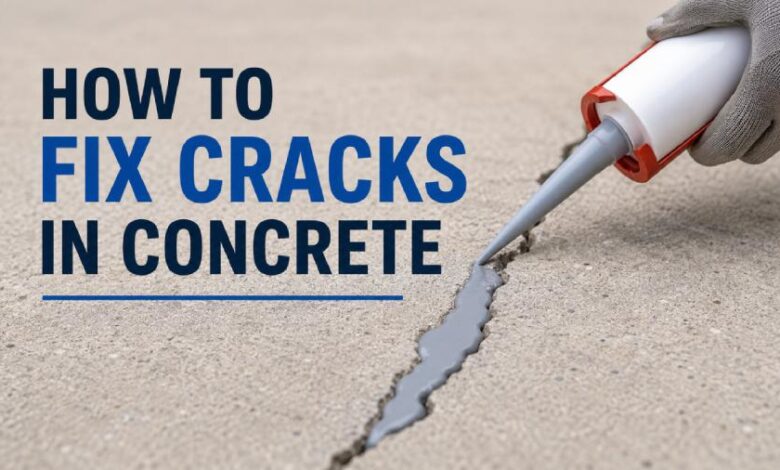
How to fix cracks in concrete depends mainly on the crack’s width, depth, location, movement, and underlying cause, but most small, stable cracks in driveways, patios, sidewalks, and garage floors can be repaired by cleaning the crack thoroughly and applying a compatible concrete crack filler or repair compound; wider or deeper cracks may require routing, backer rod, patching material, or professional evaluation, particularly when the slab has settled or continues moving. Concrete naturally develops cracks from drying shrinkage, temperature changes, improper installation, settlement, soil movement, heavy loads, roots, and freeze-thaw cycles, so the goal of a good repair is not simply to hide the line but to choose a repair method that suits the condition of the concrete.
Why Concrete Cracks and When They Need Repair
Concrete cracks when stresses within or beneath the slab exceed its ability to accommodate movement, with drying shrinkage, excess water in the original mix, inadequate curing, missing or poorly positioned control joints, settlement, erosion beneath the slab, temperature changes, tree roots, and heavy loads among the recognized causes. A thin hairline crack is often primarily cosmetic, particularly when the surrounding slab remains level and stable, but cracks can allow water to enter the concrete and become more troublesome in climates where repeated freezing and thawing occurs. Deep cracks, cracks wider than roughly 1/2 inch, widespread cracking, displaced slab sections, or cracks that continue to widen deserve more attention because filling the visible gap will not correct movement or an unstable subgrade.
Inspect the Crack Before Choosing a Repair
Before starting any concrete crack repair, examine the entire area rather than treating the visible line in isolation: measure approximately how wide the crack is, check whether its edges are solid or crumbling, look for differences in elevation between both sides, and determine whether water is entering the crack. A stable crack in a horizontal slab is generally a simpler DIY repair than a crack accompanied by settlement, vertical displacement, extensive spalling, repeated water intrusion, or obvious movement. Foundation walls and basement slabs require additional caution because cracks can permit moisture and soil gases to enter, while significant or changing foundation cracks may indicate a problem that filler alone cannot resolve.
Tools and Materials You May Need
A typical small concrete crack repair requires a stiff wire brush, broom, wet/dry vacuum, appropriate concrete crack filler, caulking gun when the product is supplied in a cartridge, and a putty knife or trowel for smoothing; wider repairs may also require a cold chisel, hammer, bonding adhesive, patching compound, and closed-cell foam backer rod. Safety glasses and work gloves should be used because brushing, chiseling, grinding, and handling repair compounds can produce dust or flying debris, while the manufacturer’s label should always determine whether additional protective equipment, ventilation, surface preparation, or temperature restrictions apply.
How to Fix Small Cracks in Concrete
For narrow, stable cracks up to approximately 1/4 inch wide, begin by removing dirt, loose concrete, weeds, and debris with a wire brush, then vacuum the remaining dust so the filler can contact sound concrete rather than loose material. Apply a concrete crack filler designed for the particular surface and crack size, working it into the entire void rather than merely laying a thin bead over the top. Some liquid fillers are designed to flow into horizontal cracks and self-level, while cartridge-applied sealants are tooled with a putty knife or similar tool according to their instructions. One current DAP liquid cement crack filler, for example, is formulated for horizontal cracks up to 1/2 inch and states a 30-to-45-minute traffic time, demonstrating why the product label matters more than a universal drying rule.
How to Repair Wide or Deep Concrete Cracks
Wider cracks require more preparation because simply filling a deep void with surface material can waste product and produce a repair that does not perform well as the concrete moves. For cracks around 1/2 inch or wider, Concrete Network recommends preparing the edges, cleaning away unsound material, and using a backer rod or other suitable material where the crack is sufficiently deep; the backer rod occupies part of the void and provides a controlled base for the repair material. Depending on the product and repair design, a wider crack may instead be undercut or formed with an inverted-V profile before a compatible patching compound is applied. Do not automatically use the same filler for every wide crack because flexible sealants, rigid patching compounds, epoxy systems, and cementitious products are designed for different conditions.
Choosing the Right Concrete Crack Filler
The best concrete crack filler depends on whether the crack is narrow or wide, stable or moving, horizontal or vertical, interior or exterior, and exposed to water or vehicle traffic. Pourable cement-based fillers can be convenient for narrow cracks in horizontal slabs, while flexible elastomeric sealants are useful where controlled movement is expected; patching compounds are more appropriate for certain wider or damaged areas, and epoxy systems are commonly used for particular stable cracks where bonding and sealing are the primary objectives. A repair material should have properties appropriate to the existing concrete and service conditions, and low shrinkage and strong adhesion are important because a repair that shrinks or loses its bond can separate from the surrounding slab.
Concrete Crack Repair for Driveways, Patios, and Sidewalks
For a driveway, patio, or sidewalk, the repair sequence is generally straightforward when the slab is stable: remove loose material, clean the crack, allow the surface to meet the product’s required moisture condition, fill the crack using a product rated for the intended application, and allow it to cure for the manufacturer’s specified period before normal use. Driveways receive vehicle loads and weather exposure, so a product suitable for a decorative patio may not be the best choice for a driveway. If the driveway has significant settlement, large sections at different elevations, extensive cracking, or tree-root interference, filling individual cracks is unlikely to address the underlying problem; Concrete Network notes that settlement can require removal and stabilization of the supporting soil rather than simple surface repair.
Repairing Cracks in Garage Floors and Basement Concrete
Garage and basement slabs deserve extra attention because cracks may be exposed to vehicle loads, moisture, groundwater, or interior humidity, and basement cracks can provide pathways for moisture and soil gases. A stable, narrow garage-floor crack can often be treated with a suitable concrete crack filler, but active water intrusion requires a product and repair method specifically designed for that condition rather than ordinary cosmetic filler. Epoxy or polyurethane injection systems may be appropriate in certain foundation or slab situations, but the correct choice depends on whether the crack is actively leaking, moving, or associated with structural movement. Before repairing a basement crack, identify whether water is entering and whether the crack is changing; persistent leakage or significant movement warrants professional assessment.
Foundation Crack Repair: When DIY Is Not Enough
Foundation Crack Repair should not be treated like an ordinary driveway crack because a foundation forms part of the building’s structural enclosure and may be affected by soil pressure, settlement, groundwater, or structural movement. Small, stable, non-structural cracks may sometimes be sealed with an appropriate foundation repair product, but a crack that is widening, accompanied by displacement, repeatedly leaks, appears alongside other foundation distress, or raises concerns about structural movement should be evaluated by a qualified professional before cosmetic repair. Filling the visible opening can reduce water entry in some situations, but it does not stabilize a moving foundation or correct settlement, drainage, or soil problems.
How Much Does Concrete Crack Repair Cost?
DIY concrete crack repair can often be completed for less than $100 when the homeowner already has basic tools, although the actual cost varies with the repair material, crack size, number of cracks, and tools required. Professional work becomes considerably more expensive when the job involves extensive cracking, slab replacement, settlement correction, root removal, or difficult access. For a useful 2026 benchmark, Angi reports concrete driveway repair costs of about $829 to $2,924, with an average of $1,872, while emphasizing that location, repair type, and damaged-area size affect the final price. These figures apply specifically to driveway repair rather than every type of concrete crack, so homeowners should treat them as typical market ranges rather than guaranteed prices.
How Long Does Concrete Crack Repair Take?
A small crack can often be prepared and filled in less than two hours, although the total project time depends on cleaning, preparation, product curing, weather, and the number of cracks being repaired. Home Depot currently lists a basic concrete-crack project as taking under two hours, while individual products can have much shorter or longer return-to-service requirements; for example, DAP states that its liquid cement crack filler can be ready for traffic in approximately 30 to 45 minutes under the specified conditions. Larger repairs may require multiple applications and several days before complete curing, so never drive, walk heavily, paint, seal, or otherwise load the repaired area earlier than the manufacturer’s instructions allow.
Common Concrete Crack Repair Mistakes to Avoid
The most common repair failures come from treating the visible crack without preparing the concrete around it, using a product outside its intended application, filling a deep void without the required backing, ignoring active movement, applying material under unsuitable weather or moisture conditions, or returning the slab to service before the repair has cured. Pressure washing can be useful during general concrete cleaning, but immediately before sealing you should follow the selected product’s moisture requirements rather than assuming the surface is ready simply because it looks clean. Another frequent mistake is expecting a repair to become invisible; even technically successful repairs can remain visible, particularly on stamped, colored, textured, or weathered concrete because the original surface pattern cannot always be reproduced exactly.
How to Prevent Concrete Cracks From Returning
Preventing every concrete crack is unrealistic because concrete naturally undergoes shrinkage and responds to temperature and environmental changes, but proper installation and maintenance can reduce unnecessary cracking and deterioration. Control joints provide intentional locations where slab movement and shrinkage can occur, while appropriate concrete mixing, adequate curing, proper subgrade preparation, drainage, and control of tree-root interference can reduce several recognized causes of cracking. Homeowners can also reduce deterioration by addressing small cracks before repeated moisture exposure and freeze-thaw cycles enlarge them, keeping drainage away from vulnerable areas, and investigating new or expanding cracks rather than repeatedly filling the same line without determining why it is moving.
When to Call a Concrete Professional
Call a qualified concrete or structural professional when cracks are large, rapidly changing, associated with settlement or displacement, spread across a substantial portion of the slab, repeatedly reopen after repair, or occur in a foundation where structural movement is suspected. Professional evaluation is also sensible when the supporting soil may have eroded or settled, tree roots are lifting the slab, groundwater is entering a basement, or the concrete has deteriorated so extensively that patching would only postpone replacement. A professional can determine whether the appropriate solution is crack filling, routing and sealing, injection, slab stabilization, partial replacement, or complete replacement rather than simply applying another layer of filler.
Conclusion
Learning how to fix cracks in concrete is useful for routine homeowner maintenance, but the repair should always begin with diagnosis rather than filler. Narrow, stable cracks in sound concrete can often be cleaned and filled successfully with a compatible product, while wider or deeper cracks need more careful preparation and may require backer rod or specialized patching materials. The most important distinction is between a surface crack that needs sealing and a moving or structural problem that needs its underlying cause corrected. When the concrete has settled, continues to move, leaks persistently, or foundation damage is suspected, professional evaluation is a better investment than repeatedly repairing the same crack.
Also read: Box Gutters Guide: Warning Signs, Repair Costs, and Maintenance Tips
FAQs
Can I fix concrete cracks myself?
Yes, many narrow, stable cracks in driveways, patios, sidewalks, and garage floors are suitable for DIY repair when the surrounding concrete remains sound and level.
What is the best filler for concrete cracks?
The best filler depends on crack width, depth, movement, location, and exposure; choose a product specifically rated for your concrete surface and repair conditions.
Should I widen a crack before filling it?
Not always. Narrow cracks may only need cleaning and filling, while certain wider cracks benefit from controlled widening or undercutting before patching.
Can I use concrete crack filler on foundation cracks?
Some products are suitable for foundation applications, but leaking, widening, displaced, or potentially structural foundation cracks should receive professional evaluation before repair.
How long does concrete crack filler last?
There is no universal lifespan because performance depends on movement, preparation, product formulation, weather, and the underlying cause; follow the manufacturer’s application requirements carefully.
When should I replace cracked concrete instead of repairing it?
Replacement may make more sense when cracking is widespread, sections have settled or shifted, the underlying soil is unstable, or repeated repairs have failed to remain effective.