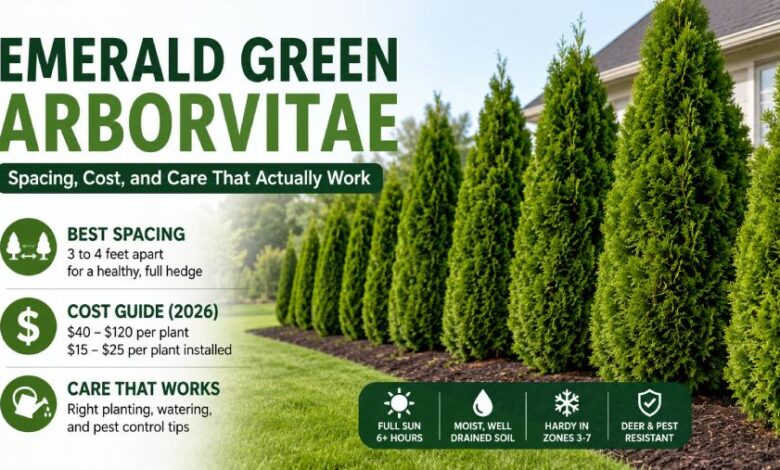
Emerald Green Arborvitae is the narrow, columnar evergreen most homeowners end up choosing when they want a privacy screen that won’t swallow the yard, and the short answer to the question behind most searches is this: it matures around 12 to 15 feet tall by only 3 to 4 feet wide, grows a modest 6 to 9 inches per year, and should be planted 3 to 4 feet apart from trunk to trunk for a hedge that fills in without strangling itself. That single spacing decision, plus drainage, accounts for the majority of failed hedges I get called out to look at. What follows is everything worth knowing before you buy: honest growth timelines, current price ranges for both plants and installation, a planting method that survives the first winter, a watering schedule broken down by year, and the pest and deer problems nobody mentions at the garden center.
What This Tree Is and Why It Dominates Privacy Plantings
Emerald Green Arborvitae is a cultivar of Thuja occidentalis, the eastern white cedar native to moist forests and swamps across the northeastern United States and eastern Canada, and its correct cultivar name is ‘Smaragd’ — Danish for “emerald,” which is precisely the trait it was selected for. The original plant was a seedling picked out in 1950 at the D.T. Poulsen Nursery in Kvistgaard, Denmark, and it went on to earn the Royal Horticultural Society’s Award of Garden Merit in 1993. What separates it from cheaper arborvitae varieties is winter color: most Thuja occidentalis types bronze or turn dull olive from December through March, while this one holds a bright green through the cold season. Combine that with a naturally tight pyramidal form that looks formal without shearing, a footprint under 4 feet wide, and cold hardiness down to roughly minus 20 degrees Fahrenheit, and you have the reason it sits in nearly every suburban side yard in the northern half of the country. It works as a screen, a windbreak, a driveway liner, and it is one of the few arborvitae narrow enough to use as a foundation planting close to a house.
Mature Size, Growth Rate, and a Realistic Privacy Timeline
Expect 12 to 15 feet tall and 3 to 4 feet wide at maturity, with roughly 8 feet of height and 18 inches of width at the ten-year mark — a genuinely useful benchmark, because it describes what you will actually be looking at through most of your ownership rather than at some distant endpoint. Growth rate is where retail listings get optimistic: the reliable figure is 6 to 9 inches per year, though growers commonly report about 6 inches annually for the first two or three seasons while roots establish, then closer to 12 inches once the plant settles in. Claims of one to two feet per year belong to Green Giant arborvitae, a different and far larger plant, and buyers who confuse the two are almost always disappointed. In practical terms, a row planted at 2 to 3 foot spacing reads as a solid wall somewhere around year three or four; at 4 to 5 foot spacing, budget five to seven years. If you need privacy this season, the only real lever is buying larger stock, since a 6-foot tree installed today gives you 6 feet of screen today, and no amount of fertilizer meaningfully accelerates a young plant.
Climate, Sun, and Soil Requirements
This cultivar is reliably hardy in USDA zones 3 through 7, and while many retailers list zone 8, that upper end is genuinely disputed — in hot southern summers the tree needs afternoon shade and consistent irrigation to look presentable, so treat zone 8 as conditional rather than comfortable. Full sun, meaning six or more hours of direct light, produces the dense growth you are paying for; the tree survives in part shade with four hours, but foliage thins noticeably and the screen becomes see-through, which defeats the entire purpose. Soil is where most failures originate. The plant wants moist, well-drained loam and tolerates sandy and clay soils as long as water actually moves through them, but it will not survive standing water, and planting into unamended heavy clay reliably produces root rot within a few years. Before digging anything, run a percolation test: fill a 12-inch-deep hole with water and see whether it drains within a few hours. If it does not, either amend the entire run generously with coarse material and organic matter or build a raised planting berm 8 to 12 inches high. Shaded, slow-draining sites also keep bark wet after rain, which invites canker infections.
Spacing: The Decision That Makes or Breaks the Hedge
Spacing is the one choice you cannot correct later without pulling plants out, and the right number depends entirely on what you are building. For a tight formal hedge, 2 to 3 feet on center closes fastest and is what many landscapers install by default, but in humid regions it eventually creates airflow problems that surface as interior browning and fungal issues around year seven or eight. For most residential privacy screens I recommend 3 to 4 feet on center, since trees knit together within three to four years and still breathe. In the humid Southeast or anywhere with heavy summer rainfall, 4 to 5 feet is the healthier long-term call even though it takes longer to fill in. For specimen or accent plantings where each tree’s natural shape should stay visible, use 5 to 6 feet. Keep trunks at least 2 to 4 feet off a fence line or wall, remembering that mature width is greatest at the base; plant at 2 feet and the lower branches will just brush the fence at maturity, which looks fine but traps moisture against both. To calculate quantity, divide the run length in feet by your chosen spacing and add one, so a 60-foot fence line at 4-foot spacing needs 16 trees.
What Emerald Green Arborvitae Costs to Buy and Install
Pricing splits into two very different markets, and knowing which one you are shopping prevents sticker shock. Plant-only stock at big-box retailers starts around $13 to $15 for a 2.5-quart starter that ships at 9 to 12 inches tall, which is genuinely cheap but means waiting eight to ten years for screening. Nursery-grade stock in the 3-to-6-foot range typically runs $45 to $150 per tree depending on region and season, and larger field-grown or balled-and-burlapped specimens climb from there, with the broader plant-only market spanning roughly $70 to $500 per tree. Installed pricing from landscape contractors commonly lands between $240 and $900 per tree for sizes from 5 to 12 feet, and some installers quote $325 to $995 with a one-year replacement warranty included. Delivery is usually a separate line item in the $40 to $110 range per order, crew labor runs about $50 to $120 per hour, and installation time is roughly one to two hours per tree for small stock or three to five hours per tree when staking, soil amendment, and irrigation are part of the scope. A typical small-to-midsize residential screen therefore lands somewhere between $1,000 and $4,000 installed. All of these figures move with your market — Northeast urban pricing tends to run 5 to 15 percent above the national middle — so treat them as planning ranges and collect two or three local quotes.
How to Plant It Correctly, Step by Step
Call 811 at least a few business days before digging, because a privacy row runs parallel to property lines, which is exactly where gas, cable, and irrigation lines like to hide, and the locate service is free. Plant in early spring or fall when soil is workable and heat stress is low, and lay out the whole row with stakes and a string line before the first shovel goes in, since eyeballing spacing across 60 feet never comes out straight. Dig each hole two to three times the width of the root ball but no deeper than the ball itself, because the single most common installation error is planting too deep, which suffocates roots and kills the tree slowly over two seasons. Set the plant so the root flare sits at or slightly above grade, cut away burlap, twine, and wire basket from the upper two-thirds of the ball, and score container-grown roots vertically in three or four places if they are circling. Backfill with the native soil you removed rather than pure compost, which creates a bathtub effect in clay, firm it gently, then water deeply to settle out air pockets. Finish with 2 to 3 inches of shredded bark mulch spread to the drip line and pulled back 3 to 4 inches from the trunk. Tools are minimal — a spade, a digging bar for rocky ground, a wheelbarrow, a tarp, pruners, and a hose — and you should budget about an hour per tree for DIY installation of 3-to-5-foot stock.
Watering, Mulching, and Feeding Through the First Three Years
Watering is where DIY plantings most often go wrong, because the failure stays invisible until it suddenly is not. For the first two to three months after planting, water deeply twice weekly, meaning a slow 30-to-45-minute soak from a hose or soaker line at the base rather than a quick pass with an oscillating sprinkler, which wets foliage and leaves the root ball dry. Through the remainder of the first year and into the second, taper to once weekly and deliver roughly an inch of water, adjusting downward when rainfall covers it. Once established at year three, supplemental water is only needed during dry spells, and about half an inch weekly is sufficient. Critically, do not stop watering in autumn: evergreens continue transpiring all winter, and a plant that enters freeze-up with a dry root ball is the one that emerges brown in March, so give one deep soak in late fall before the ground freezes. Refresh mulch to 2 to 3 inches each spring, which regulates soil temperature and substantially cuts moisture loss. Fertilizer is optional and easy to overdo — a single application of balanced slow-release 10-10-10 in March or April is plenty, and feeding a stressed or newly planted tree does more harm than good.
Pruning, Shaping, and Winter Protection
A real advantage of this cultivar is that it holds its narrow pyramidal shape with essentially no pruning, so unless you want a sheared formal look you can leave it alone indefinitely. If you do shape it, work in late winter or early spring before new growth pushes, and shear only the soft outer green foliage, because arborvitae will not regenerate from old bare interior wood and a hard cutback leaves a permanent brown hole that never fills. Trim lightly and often rather than aggressively and rarely. Tightly spaced formal hedges may need shearing several times a season once mature, while informal rows at 3-foot spacing may never need it at all. Winter protection matters more than pruning in northern climates, since heavy wet snow and ice splay multi-stemmed plants outward and permanently deform them: wrap each tree loosely with twine in a spiral from base to tip each November, or install burlap screening on the windward side. Brush snow off gently with an upward sweeping motion using a broom rather than knocking it downward, which snaps branches. When working above shoulder height, use a stable ladder on level ground with a spotter, keep electric hedge trimmer cords behind you and plugged into a GFCI outlet, and wear eye protection.
Pests, Disease, and Deer Pressure
The honest picture is that these trees are low-maintenance rather than trouble-free. Bagworms are the most damaging insect, since the larvae construct spindle-shaped bags from the tree’s own needles and stay camouflaged until foliage browns, at which point a heavy infestation can strip a plant. Hand-pick and destroy bags in winter when they stand out against bare branches, and apply Bacillus thuringiensis in late spring while larvae are small and actively feeding, generally May into June. Spider mites appear in hot, dry weather as dusty bronzing and fine yellow stippling, usually first on the hot southwest side of a structure, and a forceful hose spray or insecticidal soap handles light populations. Fletcher scale shows up as yellowing needles plus sticky honeydew. On the disease side, root rot in wet sites, Phomopsis and Kabatina tip blight, and botryosphaeria canker in shaded, slow-drying locations are the usual suspects. Then there is deer pressure, the factor most often left out of the sales pitch: Thuja occidentalis is browsed heavily, especially November through March when other forage is scarce, and trees under 4 feet are most vulnerable, producing a clean horizontal browse line at 4 to 6 feet. In high-pressure areas, fence young plants or apply repellent monthly through winter, or choose Green Giant instead. Always read and follow pesticide labels, wear gloves and eye protection, and never spray in wind or near open water.
Common Mistakes, DIY Limits, and When to Call a Professional
The recurring mistakes I see are planting into undrained clay, setting plants too deep, spacing at 18 to 24 inches because the trees look small in their pots, panic-shearing a browning plant, and misreading normal seasonal needle drop as disease. That last one is worth internalizing: all conifers shed interior foliage annually, so browning confined to the inside of the canopy in autumn while outer tips stay green is completely normal, and the diagnostic that settles it is scraping a suspect branch with a fingernail, since green tissue underneath means the branch is alive and will recover. It also pays to clear accumulated dead needles from the interior once a year, because piled debris holds moisture and encourages disease. As for doing the work yourself, planting stock up to about 5 or 6 feet is well within a fit homeowner’s ability and saves the majority of project cost, and routine watering, mulching, and light shearing are straightforward. Hire out anything involving balled-and-burlapped trees over 6 feet, which can weigh several hundred pounds and require equipment; sites needing regrading or drainage correction; runs where you want a written replacement warranty; and diagnosis of widespread browning across an established hedge, where a certified arborist or your county cooperative extension office can identify the cause before you spend money treating the wrong problem.
Conclusion
For homeowners who want a formal, cold-hardy evergreen screen in a narrow footprint, few plants earn their place as consistently as this one, but results depend almost entirely on decisions made before planting rather than on maintenance afterward. Confirm your soil drains, put the plants in full sun, space them three to four feet apart instead of crowding them, set the root flare at grade rather than burying it, and commit to deep weekly watering through the first two seasons including one final soak before winter. Get those five things right and you will have a dense, bright green wall that asks almost nothing of you for decades. Get drainage or spacing wrong and no amount of fertilizer, pruning, or spraying will rescue the row. If your site has heavy clay, serious deer pressure, or you need screening above 15 feet, take the time to compare alternatives like Green Giant or Thin Man before committing, because replacing a failed hedge costs far more than choosing the right plant the first time.
FAQs
How fast does Emerald Green Arborvitae grow per year?
Roughly 6 to 9 inches annually under good conditions, sometimes reaching 12 inches once established after year three. Faster claims usually describe Green Giant arborvitae, a much larger species.
How far apart should I plant them for privacy?
Three to four feet from trunk to trunk suits most privacy screens. Two to three feet closes faster but risks crowding, while four to five feet suits humid climates needing airflow.
Why is my arborvitae turning brown?
Interior autumn browning is normal needle shed. Whole branches browning suggests drought, root rot from poor drainage, winter burn, spider mites, or bagworms. Scrape bark checking for green tissue.
Do deer eat Emerald Green Arborvitae?
Yes, heavily, particularly in winter when other forage is scarce. Trees under four feet are most vulnerable, so use fencing or repellent from November through March.
How much does an arborvitae privacy hedge cost?
Plant-only stock commonly runs $45 to $150 per tree, while installed pricing typically ranges from $240 to $900 each. Most residential screens total $1,000 to $4,000 depending on region.
Can it grow in shade?
It tolerates partial shade with about four hours of sun but grows noticeably thinner and less dense, which undermines screening. Full sun of six-plus hours produces the best results.